Sunday, August 7, 2011

Sonic Heroes Review

Last summer, I reviewed three of the controversial 3-D Sonic games - namely, Sonic Adventure, Sonic Adventure 2, and Sonic Unleashed. This was partly due to my hype for the then-upcoming Sonic games - Sonic 4: Episode I and Sonic Colors - and also because I find 3-D Sonic games an interesting subject, what with the controversies, broken fanbases, and allegations of bias towards professional critics surrounding them. Well, this year is Sonic's 20th anniversary, and we have yet another awesome-looking game coming out called Sonic Generations. Before it comes out, I've decided to review the 3-D Sonic games I skipped over last year, just so no one feels left out.


Uhh...yeah, sorry, but not that one. I tried to play it again, but the torture was just too much to bear. That statement alone should say enough about my feelings for THAT game. I also won't be reviewing the Riders or Storybook series, as they're just spinoffs and had little influence on the direction or canon of the Sonic games overall. Instead, I will start my excursion through the remaining two 3-D Sonic games with Sonic Heroes. It was released in early 2004 to mixed reception from both the fans and the critics and is sometimes considered the point where the franchise starting its downhill spiral that it has just now broken out of. I, myself, absolutely loved it as a kid, but do I still care for it as much now that I'm an older, more seasoned gamer? It's time to find out!

------------------------------

Sonic Heroes focuses on four teams of characters: Team Sonic, made of up your usual Sonic the Hedgehog, Miles "Tails" Prower and Knuckles the Echidna; Team Dark, made up of series veterans Shadow the Hedgehog and Rouge the Bat as well as new character E-123 Omega, who is a robot that Eggman built; Team Rose, made up of Amy Rose, Cream the Rabbit (first introduced in Sonic Advance 2), and Big the Cat; and finally, Team Chaotix, made up of Espio the Chameleon, Vector the Crocodile, and Charmy the Bee, all characters from an old 32X spinoff that very few people even knew about. So why did they even bring them back? Well, we'll see soon enough. Anyway, Team Sonic's story is exactly what you would expect: Eggman's planning something evil and they've got to, in Sonic's words, "CRACK THAT EGGMAN WIDE OPEN! YEAH, LET'S PARTY!" Team Rose has to find Froggy and a lost Chao named Chocola, and Team Chaotix (being a detective agency) has to help out a mysterious client by completing missions. Team Dark's storyline is the most interesting: whilst breaking into Eggman's base, Rouge finds Omega and the thought-to-be-deceased Shadow (who can't remember anything), and they all pursue Eggman for their own reasons - Shadow for answers as to his lost memories, Rouge for treasure and Omega for revenge.

Sonic Heroes was the first 3-D Sonic game after the Adventure series, and changes things up from them by introducing the team gimmick. Rather than controlling each team member separately in their own levels as in Sonic Adventure 2, each of a team's three members are controlled at once. Each team is made up of a "speed" character, a "flight" character and a "power" character. The formation of the team changes depending on which one is the leader, and the leader can be switched out using the "Y" and "X" buttons (on the GameCube). Obviously, while in "speed" formation, the game moves at its fastest, and you will also be able to use the homing attack, which is useful for damaging enemies and sometimes even crossing gaps using said enemies. Speed characters also have a tornado move that can knock enemies off balance or take away the shields of some enemies as well as allow the team to swing off of poles, and some can even dash along a trail of rings by pressing the "B" button or jump between walls. When in "flight" formation, the characters stack on top of each other, with the flight character on top, allowing him/her to carry the entire team by flying. The flight character can also shoot the characters s/he's carrying as electrified balls to damage enemies. Finally, when in "power" formation, the team's attack power increases, making this formation useful for clearing obstacles and fighting groups of enemies. The power character can also throw other team members at enemies as fireballs, and can also float, which can be used to propel everyone upwards in areas with giant fans. You will often have to switch between characters to suit different situations or clear certain areas, and sometimes you can take a different path or shortcut depending on which formation you're in. Overall, the team gimmick is unique and places a fun twist on the usual fast platforming gameplay.

One thing that fans will appreciate is the callbacks to the original Genesis Sonic games. In the classics, there were always "Zones" with two (three in the first game) "Acts," or stages, in each, followed by a boss. Things are much the same way in Heroes. While it drops "Acts" and "Zones," you always go through two similarly-themed levels and then fight a boss before moving on to two more similarly-themed levels. Special stages also return from the classics. To access them, you have to find a caged key somewhere in the stage, and avoid getting hit for the rest of the stage to keep it. If you have it when you get to the end of the stage, you will enter the special stage. The way the special stage works is that you must gather spheres scattered around the stage to keep your boost gauge up, which you use by pressing the "B" button repeatedly, as you make your way to either the goal ring or a Chaos Emerald, and the boost will become more effective the more spheres you get. If you enter the special stage in the first of a pair of stages, your spheres will count toward your score, which will be converted into points if you get to the goal ring. If you enter in the second stage of a pair, you will be racing against a Chaos Emerald, of which you will need seven to enter the final story, and you can only have it if you catch up to it. It's actually a pretty fun special stage, and I think that the fact that you have to get the Chaos Emeralds yourself in this game rather than receiving them over the course of the story like in other 3-D Sonics makes things more interesting.

Sonic Heroes succeeds aesthetically as well. The graphics are very good for their time, featuring bright, colorful enivironments. Most of the character models are pretty good, too, but I can't help but think that a few of them are a bit shinier than they should be. Heroes also features a great soundtrack for the stages. While, as usual, I found that most of the vocal themes didn't appeal to me personally, there were a couple that I liked: namely, "This Machine," a catchy industrial rock track, and "What I'm Made Of," the final boss theme.
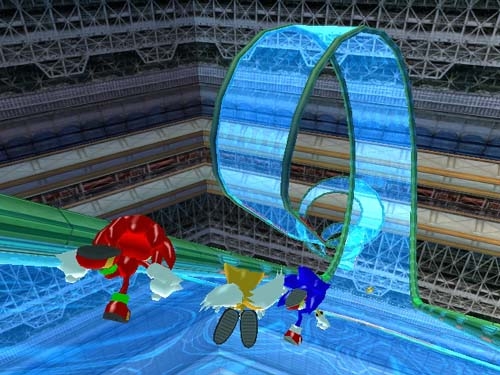
So, Sonic Heroes does get several things right. It's a bit unfortunate that the rest of the game doesn't fare quite as well. While the gimmick of the week is fun and the gameplay is as fast-paced as ever, not everything about the gameplay succeeds. First of all, the grinding mechanics in this game suck. In Sonic Adventure 2, your speed upon hitting a rail was determined by how much momentum you had beforehand. To keep moving fast, you had to hold the "B" button down to crouch, but you couldn't keep holding it down or Sonic would lose balance. In addition, while I suppose this is more related to the level design, you usually wouldn't be grinding for a very long time without having to partake in some form of interaction or platforming. None of this is so in Heroes. You still hold the "B" button to go faster, but prior momentum is not a factor when jumping onto a rail, nor is balance. Grinding pretty much boils down to holding the B button while the game does the rest for you, which is honestly kind of boring. This would just be a nitpick if it weren't for the fact that this game places a much larger emphasis on grinding than in Adventure 2. Outright automation extends to the few loops that the game has. When going through a loop, you are thrust into a semi-scripted event that strips control completely away from you. This doesn't bother me for most of the smaller loops in the game (such as the ones in Seaside Hill and Ocean Palace), but when it comes to larger ones such as those in Grand Metropolis and Frog Forest, I just found it to be pretty annoying.

The game feels pretty darn unpolished. Though I wouldn't quite call the Adventure games "polished," it was pretty rare that the glitches would intrude on the experience, at least in the Dreamcast versions. Unfortunately, I can't say the same thing for Sonic Heroes. There are times when a homing attack or light dash will backfire, which can lead to your doom. In the few boss fights where you will be using the Thunder Shoot ability, the hit detection for it can be severely off at times, leading to frustration. Also, notice that I referred to the loops in the above paragraph as "semi-scripted". Dare to let go of the control stick while running through them and the game will glitch out. It doesn't glitch out severely, but it happens. There are two levels featuring pinball mechanics, but the controls are kind of unresponsive when on the pinball tables. This was probably, to an extent, intentional, but it adds needless frustration to at least one of these stages. And none of this is even getting into the camera. 3-D camera angles were never quite Sonic's best friend, but the camera in this game sometimes likes to go through walls, and also won't always clearly show bottomless pits. If you try to turn it with the shoulder buttons, it moves pretty slowly and can sometimes make the angle even worse. Though you should be able to, you can't use the C-Stick to turn the camera around, as moving it in ANY direction causes you to switch to a useless first-person view. Just...why?

Even if these problems with the gameplay had been fixed, there is another element that's of almost equal importance in a platformer: the level design, and in Sonic Heroes, it's pretty much a mixed bag. There is a lot of variety in mechanics and gimmicks, and, as mentioned earlier, there are times when you can take a different path or shortcut depending on which team formation you're using, which is great. On the other hand, (again, as mentioned earlier) some levels feature long sections of the aforementioned boring grinding. Another problem is that the levels sometimes feel like they're relying on beat-em-up elements too much in a game that's supposed to be a platformer. I have no problem with there being SOME sections where you have to defeat a group of enemies to proceed - after all, that's one of the things that the power character is for, right? The problem is that there are just too many of them.

Boss design is even more of a mixed bag than the level design. At the end of each pair of levels you will either fight Eggman himself, one of the game's other playable teams, or several waves of enemy robots. Eggman battles are an absolute joke, and can be won just by continually spamming a single attack. Team battles, on the opposite end of the spectrum, are freaking frustrating. It's supposed to be like rock-paper-scissors, where the opposing team is in one formation and you have to choose the formation it's weak to, but the game never makes it completely clear which formation is weak to which, and even if you do figure it out, it's still pretty annoying. The only bosses that I really enjoyed were the ones that required you to fight off waves of Eggman's robots. These were legitimately difficult and pretty darn fun. In fact, if they wanted so much emphasis on beat-em-up elements, why didn't they just make a few more of those? Aside from those, the only boss I really liked was the true final boss, which, while not as great as the ones from Sonic 3 & Knuckles or the Adventure games, was still pretty fun.

Unfortunately, the problems don't quite end there. Sonic Heroes is a pretty short game...that is, it WOULD be if you didn't have to play through it three more times before gaining access to the last story! As I stated earlier, Sonic Heroes offers four teams to control. What I didn't say was that you have to complete the game with all of them to unlock the final story! Normally, I wouldn't have a problem with this; after all, you know what they say, the MORE the MERRIER! Ohohoho - no, I won't ever quote that line again. *ahem* The problem is that the order and designs of the levels are exactly the same when going through it with each team, with the only difference being in difficulty. It pretty much forces you to play through the game on hard mode (Team Dark) and easy mode (Team Rose) before allowing you to fight the final boss. If you enjoyed the game the first time, you'll probably enjoy it again, but it's a cheap way to extend the game's length nonetheless.

And then there's the final team, Team Chaotix. Earlier in the review, I questioned why they were brought back, since very few people had even played the game they came from. Well, apparently, making you play through the game on different difficulties didn't cheaply extend the length enough, so Sonic Team saw fit to shoehorn THESE guys that nobody cared about in. So what difficulty are they? Super Easy Mode? Brutally Hard Mode? Nope. Team Chaotix's levels are mission-based, either requiring you to find a certain number of items in the level or proceed through a level stealthily. If you ask me, the item collecting stages are flawed conceptually. The Adventure games had stages that required you to hunt for items, but they were open-ended in design - like they should have been. Heroes' levels are linear in design, which, when combined with the game's bad camera, can sometimes make required items easy to miss. Sometimes, if you miss JUST ONE, you'll have to go back through the entire stage AGAIN just to find it. You'll also find yourself trying to explore around a lot to make sure you're not missing anything, which will require you to try to turn the camera, and considering how bad the camera is...yeah, I'm sure you can see where I'm going with this. Especially notable is the mission in Mystic Mansion, which requires you to use your tornado ability to put out 60 red torches. How many red torches are there? 60 exactly. How long is the level? Long enough to decently space out 60 red freakin' torches.

-----------------------------

So, is Sonic Heroes the point where the series started going downhill? Unfortunately, I would have to say so. It's not quite a bad game; the gameplay can be pretty enjoyable at times and the team gimmick works well. However, almost every aspect of it is flawed in some way so that it seriously hurts the experience. Some would say that the Adventure games weren't that good, but I would still say that Heroes is the one where you could tell something was very wrong. Sorry, fans, but this one is a bargain bin purchase at best.

Score: 5/10

My Scoring System:
10 - Amazing game. Flaws are minor at best. If you don't own it, you should be ashamed of yourself. (Zelda: Ocarina of Time)

9(.5) - Fantastic game. Perhaps a couple of notable annoyances, but still a must-have. (Kingdom Hearts: Birth by Sleep)

8(.5) - Very good game. Has a few flaws, but you won't be disappointed with your purchase. (Klonoa)

7(.5) - Pretty good game that either has several problems or is just too short for its price. Enjoyable to play, but you may want to wait for the price to drop a bit before picking it up. (Rayman 3D)

6(.5) - Passable game. Has its strengths, but unless you're a fan of the series or genre, you're probably better off not bothering. (Dragon Ball Z: Budokai Tenkaichi 2)

5(.5) - Mediocre game. Not a bad experience, but it's too flawed to be much fun. A bargain bin purchase at best, and only if you're a fan of the series. (Mega Man X7)

3 or 4(.5) - Bad game. A mostly negative experience, and whatever it does right fails to save it overall. Even if you're a fan, you're probably better off not playing it. (Sonic and the Secret Rings)

1 or 2(.5) - Utter garbage. An unholy abomination that we should do all in our power to avoid playing. In other words, STAY THE HECK AWAY! (Dragon Ball Z: Ultimate Battle 22)

0 - ...No. Just freaking no. (Big Rigs: Over the Road Racing)

Tuesday, July 26, 2011

Viewtiful Joe Review


Released to critical fanfare, but middling sales back in 2003, Viewtiful Joe has been in my backlog of GameCube games for a while. Finally having gotten a chance to play through and beat it, I am now going to tell you why if you haven't already played this game (and you probably haven't), you really should. You ready? Henshin a go-go, baby! (I...can't believe I just typed that.)

------------------------------

It may have one of the lamest puns - ever - in its title, but don't let that turn you off. Viewtiful Joe is quite possibly one of the most original and fun games from the GameCube days. The plot of Viewtiful Joe involves Joe, an average movie fanatic, literally getting pulled into a superhero movie after the old hero of the movie, Captain Blue, is defeated. Becoming the film's new hero, he has to not only rescue his girlfriend, Silvia, but he also has to stop a mysterious gang called the "Jadow" from carrying out their evil plot, whatever that may be. The game is extremely cheesy and over-the-top, but intentionally so. It's meant to be an affectionate parody of both American and Japanese superhero films and comics. As such, we see things like Joe donning a red jumpsuit and striking poses whilst spouting catchphrases such as "Henshin a go-go baby!" or "Henshin a bye-bye!" (or something else involving the word "henshin") and a cast of hammy and ridiculous villains such as Hulk Davidson, the axe-weilding, green rhinoceros biker who somehow owns a hotel or Gran Bruce, a shark that, for whatever reason, wears a scuba tank. Oh, and don't forget the giant freakin' robots.


Viewtiful Joe's cel-shaded art style still looks great even eight years after its release.

Gameplay-wise, Viewtiful Joe is mostly a side-scrolling beat-em-up with some puzzle solving and platforming elements. On the outside, the gameplay looks very simple. Joe's main attacks are a simple punch (Y button) and kick (X button), and up and down on the control stick are used to dodge enemy attacks. There are a few extra moves that can be learned, but there are no flashy combo moves or anything like that. However, this is where we get to one of the things that sets Viewtiful Joe apart from other beat-em-ups: the VFX powers. Thanks to the game taking place inside of a movie, Joe can use video effects to his advantage. These video effects include slowing down the action, speeding UP the action, and making the camera zoom in on him. However, note that your use of the VFX powers is not unlimited. In the HUD, under your health, is the VFX gauge. It decreases the longer you use a VFX power, and if it fully depletes, Joe reverts back to his normal, not superpowered self, at which point he can take more damage from enemy attacks. The VFX gauge replenishes on its own, though, and it can be increased a little bit each time you collect 50 film reel pickups (although it reverts back to the original amount each time a new episode of the game starts).

Each VFX power has different effects during gameplay. For instance, holding down the L button to slow down time will make your attacks stronger, allowing you to break through enemy barriers or knock away disoriented enemies (you can disorient enemies by dodging their attacks). If you knock away a disoriented enemy, you will be able to knock away any nearby enemies, allowing you to get tons of Viewtifuls (which are converted into V-Points that can be spent on upgrades at the in-game store, and Viewtifuls are also accumulated by stringing together attacks, dodging enemy attacks and completing in-game challenges with a high rank). When in slow motion, Joe will also automatically dodge certain attacks at the expense of some of the VFX gauge. Slow motion also has varying effects on the environment, such as making explosions larger (useful for attacking enemies and blowing open certain walls) and grounding otherwise unreachable enemies or floating platforms. Holding down the R button to go into "Mach Speed" mode allows Joe to attack enemies with lightning-fast flurries of punches and kicks, which will cause afterimages to attack other enemies and even set Joe on fire, allowing him to burn other enemies. The Mach Speed move also has effects on the environment, such as causing floating platforms to rise even higher or making water run faster, raising the water level. The final VFX power causes the camera to zoom in on Joe. While the camera is like this, Joe can no longer string together punches and kicks, but his punches become far stronger and his kick becomes a spinning kick that can attack several enemies at once. Jumping while the camera is zoomed in causes Joe to do a spinning attack upwards, and if you zoom in while in the air, Joe will do a ground pound, damaging all nearby enemies. This power can be used along with one of the others to have different effects.

VFX powers aren't just used during combat. You will often find yourself using them to solve puzzles as well. For the most part, puzzles in the game are pretty quick and straightforward so as not to break up the fast-paced action. There will be very few times when you will be outright stumped as to what to do. However, puzzles are still fun and keep the game from getting repetitive, and often make clever use of your abilities.

Quite possibly the best thing about the game, however, is its difficulty, particularly how it handles it. Viewtiful Joe is a very hard game. The first episode is easy enough, but the difficulty really picks up and steadily increases after that, with the game becoming extremely hard by the end. It's not too forgiving, either; following the first episode, health pickups won't be all that common, and if you get a game over, it's back to the start of the area for you. That said, Viewtiful Joe is pretty much the definition of "fair". The game's enemies are challenging, but you never feel overwhelmed, and you can usually avoid their attacks if you're careful enough. Also, before the start of an episode, at an episode's mid-point, and before a boss, you are allowed to trade in V-Points, collected in the form of coins and also by accumulating Viewtifuls in combat, for upgrades. If you get a game over, you keep all the V-Points you collected before you got a game over and you are sent back to the store, allowing you to buy upgrades that might make your life easier the next time through. Bosses in the game are a similar case. They all have attack patterns and fairly simplistic ways of beating them, but it's not always easy to figure it out. Even when you DO figure it out, they're still not quite easy, as you have to be careful about dodging their attacks lest you get owned, and thanks to the ever present threat of combo breakers, you have to know when to STOP attacking. In short, Viewtiful Joe is one of the few games where having a high difficulty level actually adds to the experience rather than takes away from it. If you die - and you WILL die - it's YOUR fault, and that's something I always love to see in a video game.

As for flaws, there aren't that many, but they are there. My main problem with the game is that, while you are able to save before and at the mid-point of each new episode, you can't save before the bosses. Not only is this a bit pointless, but bosses generally take quite a long time to defeat. If I want to take a break, I should be able to take a freaking break! The only other flaw in the game may or may not bother you. I personally found the fourth episode of the game to be a bit tedious. For one thing, it's a lot slower than the others, which, to me, felt like it was breaking the game's otherwise fast pace. It also features some mildly confusing level design and a couple of annoying puzzles, and the second area of it felt like it was dragging on a bit. It's not a bad or unfun episode, but it definitely felt like the low point of the game for me. These flaws don't make the game any less worth your time, but they still deserve mentioning.

-------------------------------

Even at its lowest points, Viewtiful Joe is a dang good time. Featuring unique gameplay and a difficulty level that will kick your butt but remains fair throughout, it was one of the best games on the GameCube and it's still one of the most fun games you could be playing on a Nintendo console right now. If you're looking for a good challenge, or if you're a fan of beat-em-ups or just action games in general, Viewtiful Joe is the game for you. With that said, henshin a-bye-bye! (...Did I seriously type that? AGAIN?!)

Score: 9/10

Friday, July 22, 2011

The Legend of Zelda: Ocarina of Time 3D Review


The Legend of Zelda: Ocarina of Time came out for the Nintendo 64 to immense fanfare back in 1998, and it is still considered one of the greatest games of all time. Though I didn't get to experience until 2004, I very much loved it, and I still consider it one of my favorite games of all time. Needless to say, many people were eager to experience it again when a remake of it was announced for the 3DS. It came out a month ago, and I myself picked it up along with my own 3DS. Setting aside all hype and nostalgia, what does the 3DS version offer that's new and how well has the game aged? The answers to both questions are in this review.


-------------------------------------------
I'll begin my review by going over the changes Ocarina of Time 3D makes to the N64 version. Probably the most immediately noticeable improvement made in the 3DS version of Ocarina of Time is the graphics. The graphics have been mostly redone, featuring new, better character models for Link, most enemies and other major characters; 3-D models for pick-ups found in the field rather than 2-D sprites; and a bright, colorful and outright beautiful art style. The only thing in the game that looks dated are the models for minor NPCs, which, for the most part, look like they came straight from a thirteen-year-old Nintendo 64 game. Another thing that hasn't changed at all is the MIDI soundtrack, which is probably the remake's greatest weakness. It's still by all standards a great and memorable soundtrack, but a fully orchestrated version was definitely called for.

That's not even getting into the use of the 3-D effect. In my review of Rayman 3D, I mentioned that turning the 3-D on did little to make the game's horribly dated visuals look any better, and admittedly, I feared that this meant the 3DS' supposed 3-D capabilities wouldn't offer much overall. Fortunately, Ocarina of Time 3D has thoroughly proven me wrong. Playing the game with the 3-D feature on allows you to see the depth of the world, bringing the game to life in a way that playing without it simply cannot. It's especially noticeable during the cutscenes. There's some ghosting here and there, but it still looks amazing and greatly enhances the visual experience and presentation.

Several changes have been made aside from the visuals as well. Most notably, menu navigation and interface have been highly improved thanks to the use of the touch screen. In the 3DS version, you have five slots to ready items for use rather than three. One of them is set aside specifically for the Ocarina, meaning that you won't have to bother rummaging through menus to get it out, two allow you to use items with the X and Y buttons, and there are two more slots that you use the touch screen for. Using the touch screen may sound impractical for some items, but once you get used to it, it works great. Menu navigation is also far faster now, allowing you to switch between items and weapons in much less time than in the original version. Combine that with the fact that the iron boots can now be assigned to one of five said slots, and (on that note) it has, in fact, been redesigned to make it less confusing, and the once notoriously tedious Water Temple is now just as fun as any other dungeon in the game.

One more change has been made to the controls. When using items controlled in first-person, such as the hookshot or bow, you are now given the option of using either the control pad or the 3DS itself to aim them (thanks to the 3DS' built-in gyroscope). Though using the gyroscope may sound gimmicky, it's noticeably more smooth and precise than when aiming with the control stick, and once you've done it for a while, you'll never be able to go back to using the control stick again.

The only other notable changes made to the 3DS remake are that the Master Quest version of the game is unlocked after you beat the normal version, and there is also a boss rush mode (playable by sleeping in Link's childhood bed in the past after a certain point in the game). Ocarina of Time Master Quest was originally a bonus game that you could get if you preordered The Wind Waker, and in it, the dungeon designs were changed to be more difficult. It was nice, but in the 3DS version of the game, not only are the dungeon designs remixed, but the game has been completely mirrored and Link now takes double damage. Combined with the new dungeon designs, it makes for a more interesting, far more difficult experience.

As for the game itself, it's aged amazingly well. One thing that it got a lot of praise for when it first came out is how lengthy it was. While by today's standards, it's not exactly "long", it's by no means a short game either. Most gamers will take about 20-30 hours to complete it on their first try, and that's not even counting the sheer number of side quests in the game. In fact, this shorter length can, in some ways, be considered an advantage over later Zeldas. Not only does it allow the game to have more replayability, but pacing and plot progression are pretty much flawless. There's always a sense of progression and the game never feels like it's dragging on. The game also never relies on padding to extend its length, not at any point devolving into mandatory fetch quests - something that Wind Waker and Twilight Princess are extremely guilty of - and providing a field that holds no shortage of secrets but is small enough that it's easy to navigate if you just want to speed through the game, something that those who weren't fans of Wind Waker's sailing will consider a godsend. But why speed through the game when there are so many optional quests to do? From finding all the Heart Containers to getting the Biggoron's Sword to killing all 100 Gold Skulltullas, Ocarina of Time continues to impress thirteen years later with the amount of worthwhile side quests it holds.

Combat in the game can best be described as simple, yet satisfying. Though Link's moveset is more limited than in later games in the series, sword combat is still fun and the targeting system works great. And you can't talk about combat without talking about bosses, and while later 3-D Zeldas (for the most part) had better bosses in my opinion, the game's ten main bosses are still great and a lot of fun to fight, each having their own strategies for defeating them. My favorite boss would probably have to be Barinade from the third dungeon.

Speaking of the dungeons, each of the game's eleven dungeons are just as beautifully designed as they were thirteen years ago. Each dungeon features its own unique mechanics and clever puzzles. The Master Quest version of the game provides interesting and extremely clever redesigns of said dungeons, and often puts to better use mechanics and items that weren't used so much in the original version, such as the time blocks and fire arrows. They also live up to the promise of being more difficult. Trust me, if you've not played it before, you will need to use a guide at some points.

---------------------------------

It's really amazing to look at Ocarina of Time and see just how well it's aged. Thirteen years after its release and it's still one of the best games out there, and thanks to the changes made to the remake it's even better on 3DS. The only things about the game that are "dated" are purely aesthetic, and even then, it's mostly just the sound quality of the music. In a perfect world, all of our old favorites would be like this: timeless masterpieces that can be played and enjoyed by all generations of gamers; games that we could one day show to our kids, and that they would love as much as we did. But alas, standards for playtime and gameplay change as gaming technology progresses, and games that were once amazing may one day end up being considered bland and average. It's still a possibility that Ocarina of Time could one day be considered dated, if its sword combat becomes too simplistic or 20-30 hours eventually becomes too short for a game to be worth full price, but considering how well it still holds up after thirteen years, that day obviously isn't coming anytime soon. Though Skyward Sword may change this after it comes out, later Zeldas may have done some things better, but as it stands, Ocarina of Time is the only one to have done everything else perfectly. If you haven't played this game, well, you should be ashamed of yourself, and get this game as soon as possible! The 3DS version is the definitive version, but the original version is still great, so you should pick it up whether you own or are planning to own a 3DS or not.

One thing simply has to be said though: It's kind of sad that the best game on 3DS right now is a remake of an old game. I'm sorry, but it just is.

Score: 10/10

Sunday, June 26, 2011

Sonic Generations Demo Impressions


At this point, a lot of people would agree that 2010 was, at the very least, a better year than we’ve come to expect from Sonic. Sure, there was Free Riders and the TERRIBLY done XBLA/PSN port of Sonic Adventure, and due to its (often seen as negative) deviations from the Genesis games to which it is touted a sequel – and I’m not just talking about GREEN EYES – Sonic 4: Episode I has earned a reputation as a very love it or hate it game – quite unfortunate for the first part of a game that is meant to be Sonic’s opus, but given Sonic’s track record on consoles throughout the latter half of the 2000s, it’s honestly (and sadly) somewhat respectable. But then we have Sonic Colors, which rocked both of Nintendo’s current systems last Christmas, and while it didn’t satisfy absolutely everyone, I personally thought it was awesome, and it’s the first 3-D Sonic game since the Dreamcast version of Sonic Adventure 2 to secure a position in the green on Metacritic. Heck, it even got an 8.5/10 from IGN. Let that sink in. A 3-D Sonic game got a great review from IGN.

Unfortunately, gamers and the gaming press at large tend to ignore this fact, as demonstrated by this Kotaku article. Even IGN, whom lauded both Sonic 4 and Colors with praise, would rather point out Sonic’s missteps in their already-infamous history of Sonic feature, posted the other day, rather than many of the games that succeeded. Perhaps it’s to be expected, though. We’ve been burned so badly for so long that perhaps it will take quite a while to forget the pain. Or maybe we need one game so amazing that it will be nearly impossible to deny that Sonic is back.

That is what Sonic Generations, coming to 360 and PS3 this holiday, is setting out to do – and, even better, looks like it WILL do. It features two separate play styles a la Sonic Unleashed, but don’t worry: no stretchy-armed monstrosities this time! Instead, as part of the celebration of 20 years of Sonic, we will be playing as two different Sonics – the rounder, cuter, more childish Sonic that Genesis kids will remember, and the taller, leaner, green-eyed Sonic that my generation knows and loves – or “Ruined Forever Sonic”, as I like to call him after a small but annoyingly vocal faction of fans’ reaction to his presence in Sonic 4. Classic Sonic’s levels feature fast platforming based around momentum physics reminiscent of the Genesis titles from which he hails, and, judging from what we’ve seen, “Ruined Forever Sonic” combines the best elements of Unleashed – that is, the GOOD levels from Unleashed (the amazing sense of speed and seamlessly switching between 2-D and 3-D perspectives) – with the best elements of Colors (enjoyable sections of straight-up platforming). Keeping with the theme, each of the game’s levels are based on locales from Sonic’s previous adventures, (Green Hill from Sonic 1 and City Escape from Sonic Adventure 2 being the ones thus far shown) all reimagined in glorious HD, with remixed music, levels designed to fit the two play styles, and perhaps a few surprises a long the way. You know you want it.

And just to show even further how much they love us, for a limited time (20 days to be exact, starting at June 23, Sonic’s official birthday) SEGA is offering a free demo of the beta version on Xbox Live and PSN to give us a little taste of what we’re going to get. Although we can likely expect to get to play as “Ruined Forever Sonic” at some point, so far only Classic Sonic’s Green Hill Zone is playable. Over the past few days, I have played the demo almost non-stop, analyzing it as if it were some elaborate, complex, deep work of art meant to be studied and appreciated. I’ve played it until I’ve gotten bored with it, and then played it some more, and I can safely say that while there are improvements that can and probably should be made in the months leading up to the game’s release, it’s probably time to put all of our fears and doubts to rest. Ladies and gentlemen, the demo of Sonic Generations is awesome.

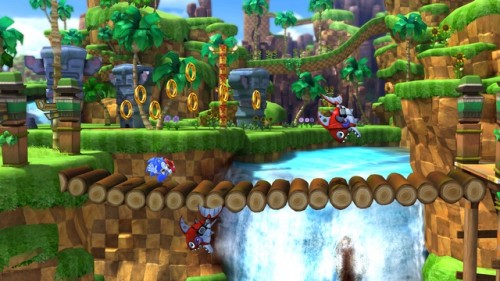
The first thing I want to go over is the visuals. Green Hill Zone has never looked so great. The lighting effects and colors are simply gorgeous, and the zone’s checkerboard patterned walls and grass are beautifully detailed and generally look fantastic HD. But even aside from that, the level just feels so alive. As you run through the level, you will pass by numerous giant totem poles and be able to admire the surreal landscape of the level. It’s not content to bore you with repetitive scenery, either, and as you traverse the stage you will venture into dimly-lit caves and run along mountaintops. Classic Sonic’s model is also highly detailed, as are those of the enemies in the game, which seem to have been given somewhat of a metallic shine. Definitely a nice touch. Oh, and while I’m at it, the remix of Green Hill Zone’s original theme is VERY nice.

Of course, at this point Sonic Team knows better than to put all of the work into the graphics, and it certainly shows. The first thing most of you who were disappointed with Sonic 4 are probably wondering is if they got Sonic’s physics right this time. For the most part, yes, they did. When running or during a spindash, Sonic carries and maintains momentum just as he did in the classics and just as he should. Perhaps the best way that Sonic Team has shown their work is that it’s even incorporated into the level design, as you will need to make use of Sonic’s momentum to go through loops and to take some of the faster paths through the stage. Oh, and when coming off of a quarterpipe, he doesn’t uncurl either, if that bothered you, you unpleasable little retro nerd (kidding). Unfortunately, not all is perfect with the physics. In fact, this brings me to the first negative point I will mention: pressing down while running (which causes Sonic to roll into a ball briefly), while not as useless as it was in Sonic 4, generally only slows you down from my experience. It’s not a big disappointment, but it’s something I’d like to see fixed by the time the game is released.

Now, there IS another change that has been made to the physics, but it seems to be intentional. Bouncing off of an enemy no longer causes you to bounce to a height proportional to how much downward momentum you gained. Instead, the height is always fixed. I say this is intentional because bouncing off of enemies seems to have been made into a sort of “double jump” now. This is demonstrated very well by a section toward the beginning of the stage where you have two paths to take: a lower route through a tube that will overall be a slower route, and a higher route on a ledge that Sonic can’t jump to normally. However, there is a purple bee enemy flying back and forth, and if you can time a jump so that you can hit it while it’s close enough to the ledge, you will bounce off of it and be able to reach the ledge. It’s a mechanic that works well and that I hope to see used more often in the game’s levels.

This brings me to yet another of the demo’s major strengths: the level present is EXTREMELY well designed. The level blends speed and platforming very well, just as the Genesis games did, but that’s not even the best part. The level is multi-layered like in the classics, featuring an upper, middle, and lower path, the upper path being the fastest to take but the hardest to stay on. This is where you can REALLY tell that Sonic Team knows what they’re doing, because as I continued to replay the demo, for the first ten or so playthroughs I kept finding new areas and shortcuts through the level. There are TONS of different pathways and shortcuts to take in this one stage, and it truly captures the freedom and exploration that set the Genesis games apart from other platformers way back in the early 90’s along with Sonic's speed. Oh, and as mentioned before, to take the fastest paths through the stage, you will need to utilize Newton’s third law of motion to your advantage. If the first stage of the entire freaking game is like this, then just think, what will the rest of the classic stages be like?
He's waaaaaiting...


Now, a common criticism of the game (aside from the poor implementation of the rolling mechanic) from those who have played it is that Sonic feels kind of heavy and stiff, and I will have to concur. It’s nothing game breaking, but it’s definitely noticeable and it’s something that should be fixed. I’ve also heard people complaining about things like the number of scripted events in the stage, how springs are activated by hitting them from any side rather than by jumping on them (and are also scripted) and that the stage has more automated segments than the classics. Though I do think that changing some of this could help the game to feel even more like the Genesis games, I honestly didn’t take issue with any of these points. Not enough of the level is fully scripted or automated to detract from it in my opinion, and the thing about being able to use a spring from any side seems really inconsequential anyway. Really, just polish it up, fix the rolling, make Sonic feel lighter to control, and make the spindash a bit weaker and I think this game will be ready to play this Christmas.

Anyway, those are my thoughts on the Generations demo. Now, SEGA, getting to play a classic level of this game early is great and all…but when those 20 days are up, will you let us play Modern Sonic’s level a bit? Please?

Thursday, June 23, 2011

Sly Cooper Series/The Sly Collection Review


When I get nostalgic for the early and mid 2000s, my mind always turns to Sly Cooper, an anthropomorphic raccoon who was one of the PlayStation 2’s three mascots, along with Jak & Daxter and Ratchet & Clank, back in the day (and the only one I really grew up on). The entire series was remastered for PS3 last year, and an unlockable extra was a teaser for “Sly 4." This year at E3 brought a brand new trailer as well as gameplay footage (!!!!) for the game that is now titled “Sly Cooper: Thieves in Time,” developed by the up-and-coming Sanzaru Games rather than Sucker Punch, whom have moved on to the Infamous series. All three instances reduced me to a state of giggling with childish glee as if I were once again nine years old. Of course, that’s an age where you can say that Nickelback produces deep and meaningful music without getting simultaneously punched in the face by every intelligent human being on Planet Earth. Before I got too excited, I decided to go back and play through the original PS2 trilogy, partially to relive some good childhood memories and partially to see if my love for the series wasn’t just me viewing it through nostalgia goggles. Here are my reviews for the games in the Sly Cooper series. They are based on the PS2 versions of the games (as I do not own the collection), but this also doubles as my review for the PS3 collection. Also, this is going to be pretty long, so bear with me.

*Also note that this review will contain some spoilers for the plot of Sly 1, which will appear in the first paragraph of the Sly 2 review.*

-----General praises----

If there’s one thing that has remained completely consistent across all three games in the franchise, it’s the fact that each game feels like you’re playing a cartoon, and this is completely intentional. Much as Infamous went for a comic book feel, the Sly Cooper series goes for a cartoon feel and, just like Infamous, does so exceptionally well. Most obviously, the cutscenes that take place before and after “episodes” of the games are made completely using 2-D, cartoonish art, albeit with somewhat limited animation (in the first game moreso than the others), and the aesthetics in general are very reminiscent of cartoons. The cartoon feel runs deeper than the visual style, however. The plot of each game features a “monster of the week” setup, with all of the games’ episodes featuring a different villain, and each character (including the villains) has a defining personality.

Another thing I greatly appreciate the series for is that, by platformer standards, the series as a whole has a very well-done and sometimes even dark storyline, with protagonists that you really like and care about and villains that you really hate. Being a cartoonish series about an anthropomorphic raccoon who steals stuff, the games know not to take themselves too seriously and always find the time to inject some comic relief into a situation, but really, for platformers, these games have a very interesting plot (Sly 2 and 3 moreso than the first).

-----Sly Cooper and the Thievious Raccoonus Review-----

I will start my excursion through the franchise with the first game, Sly Cooper and the Thievious Raccoonus. Sly Cooper and the Thievious Raccoonus (hereon referred to as “Sly 1”) introduces us to – wait for it – Sly Cooper, an anthropomorphic raccoon who comes from a family of thieves that goes back hundreds of years, and each of these thieves have learned their techniques from a book called – wait for it – the Thievious Raccoonus, and each of these thieves has also added their own techniques to the book. Also, apparently the Cooper family only steals from other criminals, cause, you know, I guess that makes you somewhat less of a butthole? Regardless, when Sly was a kid, a group called the Fiendish Five broke into their home, brutally murdered his dad, ripped the book’s pages out of it and then left with said pages. Well, gee, that’s not nice, is it? Now, Sly is an adult with two trusty companions: Bentley, an intelligent turtle who handles most of the technical crap, and, the ehm…pink…hippo-thing, Murray, who, in this game only, exists solely to drive the gang between locations in the Cooper equivalent of the Mystery Machine. To keep his family name worth something, Sly must find the Fiendish Five, exact sweet vengeance and steal back the pages of the Thievious Raccoonus. Along the way, they must avoid Carmelita, a fox cop who wants nothing more than to see the gang incarcerated.

Sly 1’s gameplay can be best described as something like Metal Gear meets Crash Bandicoot. For the most part, the game plays as a linear platformer. You jump from platform to platform, kill stuff and break stuff while collecting coins. Sly can only take one hit normally, but you can collect up to two magically delicious lucky charms (no, it’s not really the cereal) that will allow you to take more damage. You will find lucky charms as you go through the levels, but you can also get lucky charms by getting 100 coins, and if you already have two of them, getting 100 coins will net you an extra life. One of the things that make Sly stand out amongst platformers is the element of stealth in the game. Part of the challenge of the game is avoiding laser security and spotlights, as getting caught will result in an alarm going off followed by the lasers and spotlights becoming heat rays ready to burn your flesh. The game also features flashlight-carrying guards whose attacks are tougher to avoid than those of other enemies, and if one catches you, they’ll blow a whistle that will send other such guards rushing to their location, all with a thirst for blood. You don’t want that, so it’s in your best interest to dispatch of them stealthily.


Another thing that makes Sly stand out is the incorporation of parkour elements into the gameplay. Sly carries a cane with a rounded end. Aside from being used as his main method of attack, he can also use it to grab onto hooks, done rather famously by jumping and then hitting the circle button. After grabbing onto a hook, you can then swing back and forth to gain enough momentum to jump to your next destination, provided you don’t already have enough momentum. Sly can also use his cane to grab onto and then climb up and down poles and pipes, done by, again, jumping and hitting the circle button. As the game progresses, you learn two more moves requiring the amazing button combination – the Ninja Spire Jump, which allows you to land safely on narrow surfaces, and the Rail Walk and Rail Slide, which allow you to walk and slide on said narrow surfaces. These parkour and stealth elements are woven into the platforming gameplay very well, making for a fun platforming experience with impressive level design.

Of course, platforming isn’t all you’ll be doing in Sly Cooper. Though Sly is the only playable character for most of the game, you will get to play as Murray and Bentley…sort of. Murray gets a few driving levels (two of them involving racing) and Bentley gets a computer hacking level, played as a top-down shooter, toward the end of the game. Not every moment spent playing as Sly is spent platforming either. There are two missions in the game where you are riding in a hovercraft with a gun attached, and you get to drive around killing stuff as you make your way to the end of the level. There are also a few missions where you have to defend a character making his way to a key by shooting all enemies and obstacles in his path, one of these aforementioned levels being played as Carmelita. These brief alternate gameplay levels are fairly enjoyable and add some nice variety to the game.

One critcism that Sly 1 sometimes got was that it’s too easy, and, well...I would have to disagree. Maybe I just suck, but I found the game to be fairly challenging, especially the five bosses…well, three of them. With the exception of the Panda King, whom you can win against by simply smacking him with your cane constantly – no, really – and Raleigh, where all you have to do is wait for him to be vulnerable so that you can smack him with your cane, the bosses are difficult and have interesting ways of defeating them. The battle with Muggshot, for instance, takes place in a room with multiple levels, each having a set of mirrors and crystals. Whilst avoiding gunfire from Muggshot, you must hit the mirrors with your cane to make light shine on the crystals, and once all of the crystals are lit, Muggshot’s guns will melt from the heat. This will force him to retreat to the next level of the room in order to get replacements. You follow him, and then the battle continues in a similar manner, except more difficult. Also, Mizz Ruby’s battle is played as a rhythm game. She will send energy blasts in the shape of controller buttons at you, and you must press the corresponding buttons to avoid them as you continue towards her so that you can land a hit.

With all of that going for it, Sly 1 could have been a great game. Unfortunately, there is a major flaw: it’s…pretty freakin’ short. Most gamers should be able to beat it within three days at the most. Granted, there are collectible clue bottles in the game, and finding all of them will reveal the combination to a vault containing a page of the Thievious Raccoonus (which will unlock a new move), and there are also challenges to complete a level within a certain amount of time, which will unlock developer commentaries. However, with the exception of the dive attack and the moves that allowed you to fall into water and off cliffs without taking damage, I rarely found myself using the extra moves, and does anyone seriously care that much about developer commentaries? Though it’s fun while it lasts, the short length makes it kind of hard to recommend for full price. Of course, given its age, it’s highly unlikely any game store would be selling it for full price, but it’s still worth mentioning.

Score: 7.5/10

-----Sly 2: Band of Thieves Review-----

Sly 2 picks up two years after the original Sly Cooper. Clockwerk, the mechanical final boss of the first game, has been defeated and disassembled and his parts are now at a museum. In an attempt to make sure that he never returns, Sly and the gang break into the museum to find that the parts have already been stolen. They are confronted by Carmelita and new character Constable Neyla, the latter of whom mentions that the “Klaww Gang” may have stolen the parts. Further research indicates that they may indeed have, which results in the gang once again traveling all over the world to steal from a group of international criminals. Fun, right?

Sly 2 is a very different game than Sly 1. Rather than a straight-up platformer with stealth and parkour elements, Sly 2 is a mission-based, open world game. The game has eight playable worlds, each with their own missions, and the stealth and parkour elements are the rule rather than the exception. The game also introduces several new abilities for Sly. Sly can now perform stealth kills on unsuspecting enemies, and can also pickpocket enemies for coins and even treasure that you can sell on the Internet for even more coins. Speaking of which, although collectible clue bottles return with the same purpose, coins are now used to purchase new moves and items for Sly and the rest of the cast. They’re not as useful as the ones you find in vaults (unless you’re required to get them to continue), but some of them are still pretty cool. Oh, and each character has a health bar now, which is very nice.

This brings me to another major addition to the game: Bentley and Murray are now playable characters. Sly is the character you’ll be using the most and he is my favorite character to control, but that’s not to say that Bentley and Murray aren’t pretty dang fun to control as well. Murray is no longer the cowardly, pink hippo-thing he was in Sly 1. He’s…well, he’s still pink, but he’s now the main fighter of the group. He can pick up objects or even unsuspecting enemies and throw them at other enemies, and also has a “thunder flop” move that creates a shockwave when he lands. Combat isn’t Bentley’s strong suit, and it shows. However, he is able to put guards to sleep by going into first-person view and then firing a tranquilizer dart at them, after which he can lay a bomb next to them and just wait for the sweet satisfaction of seeing them get blown to smithereens. Bentley’s hacking missions return from the previous game, and he also has an RC chopper that he uses for missions that require air support.

As I played through Sly 2 again, I realized that I had forgotten how much I loved it. In fact, bearing in mind that I have yet to play Infamous 2, I would say that Sly 2 is Sucker Punch’s best game yet. Yes, even better than the original Infamous, and allow me to explain why. One of my main problems with Infamous was that there wasn’t that much variety in side missions, which resulted in them getting kind of repetitive. The story missions weren’t repetitive, but as I recall for the most part you were shooting stuff with lightning. Now, I love shooting stuff with lightning, but let’s take a look at Sly 2. There are very few missions in the game that ask you to do quite the same thing as another mission, and playing the game never gets old. Another thing that I love about Sly 2’s missions is how you never feel like you’re doing something just for the sake of doing something. Every mission feels like you’re doing something that’s essential to accomplishing the objective at hand, and at the end of every episode there is a big, final job where every character gets a chance to shine and you (usually) get what you came for and sometimes even fight a boss. Combine that with the multiple playable characters and the fact that the gameplay is noticeably more polished, and you have what is in my opinion a better game than Infamous.

Sly 2 is considerably longer than Sly 1, featuring eight full episodes as opposed to five, and the episodes take longer to complete overall. Also, I found the plot and the cast of villains to be a lot more interesting than that of the original Sly Cooper. Really, the only thing that I find wrong with Sly 2 is how, in areas where there are several things that Sly can land on or grab onto (by jumping and hitting the circle button, of course), Sly won’t always grab/land on the thing you want him to unless you are right next to it, which can be a bit frustrating.

Score: 9/10

-----Sly 3: Honor Among Thieves Review-----

In Sly 3, Sly learns about the Cooper Vault, which holds everything his family has ever stolen, and his cane is the key. Unfortunately, the island it’s on is owned by the nefarious Dr. M, who has been trying to open the vault himself and keeps the island under heavy security. Sly, along with a group of (at this point kept hidden, except for Bentley) characters, makes it to the Cooper Vault, when he is stopped by Dr. M, who attacks him using one of his gigantic genetic engineering experiments. Whilst being crushed to death, he remembers how he recruited everyone he needed to get there, and the first five episodes are those memories.

Although I have a lot of fondness and nostalgia for Sly 3, I remembered that as a kid I never liked it quite as much as Sly 2. When I was first getting into it again, I didn’t quite understand why. The gameplay is mostly the same as Sly 2, but it feels a lot more polished and refined, and some changes have been made that are small, but do help to make the game more enjoyable. For instance, Bentley, left in a wheelchair after the events of Sly 2, is a lot faster and can jump a lot higher (thanks to his jet thrusters), and can even upgrade his jump so that he can jump four times. He also has his own method of stealth killing and pickpocketing enemies now, as does Murray.

In addition, five new playable characters have been added in since Sly 2 (although you can only use them for certain missions). Carmelita makes her first fully controllable appearance, allowing us to blast people in the face with her shock pistol. The Guru is perhaps the most interesting new character, being able to jump on enemies’ backs to possess and then ride them, which is really freaking fun if I do say so myself. Penelope is now in charge of the RC vehicles rather than Bentley. She uses a chopper with a claw that she can use to yank enemies and toss them away as well as an RC car outfitted with turrets. The Panda King, who was a boss in Sly 1, can lock onto enemies and use his fireworks to blast stuff – which is awesome. Finally, Dimitri, who was a boss in Sly 2, has...first-person underwater diving missions. Yes, in a series where none of the fully controllable cast OR the enemies is able to swim at all, one character has first-person underwater diving missions. But I’m getting ahead of myself.

Anyway, as a kid, I never liked Sly 3 quite as much as Sly 2, and as I got farther into it, I remembered why. To start with, what’s another way that Sly 3 tries to change things up from Sly 2? Well, whereas Sly 2 had a lot of variety in objectives, Sly 3 has a lot of variety in gameplay, and that’s its greatest weakness. Now, don’t get me wrong, having variety in gameplay is not an inherently bad thing. In fact, Sly 1 and 2 had areas and missions where the gameplay changed entirely as well, albeit in smaller amounts, and it helped to further add variety to the games. The problem with Sly 3 is that a decently-sized chunk of it isn’t even played as a platformer. The addition of more playable characters is partially to blame for this. As mentioned before, Penelope is now in charge of RC vehicles in the game. What I didn’t mention is that you are going to spend a lot of missions controlling said RC vehicles. That’s not to say that it’s not fun, though. What isn’t fun is playing as Dimitri. The first mission with him can best be described as bland, boring, uneventful, and boring. Did I mention it was boring? His second mission, up until the boss fight (which was sort of fun), is needlessly frustrating due to awkward control. Thank God you only have to control him twice in the entire game.

All that said, most of the characters fit in fairly well with Sly, Bentley and Murray. However, a fair number of the missions played with them don’t even feature platforming. Heck, half of the fifth episode of the game is spent on a pirate ship where you engage in battles with other ships. Now, there’s something I want to clarify here: except for Dimitri’s gameplay, the problem is not that these alternate gameplay sections aren’t fun. In fact, I rather enjoyed most of them. The problem is that it feels like the game can’t decide what it wants to be. Does it want to be a platformer? Does it want to be a dogfighting game? Does it want to be a driving game? Does it want to be a DIVING game?

Another thing that I didn’t like about Sly 3, at least when compared to Sly 2, was the amount of time spent playing as the title character. I think the other characters – except for Dimitri, of course – are a lot of fun to play as, but I mentioned in my review of Sly 2 that Sly was my favorite character to control, and that still holds true for Sly 3. So why am I hardly spending half the game controlling the title character? Also, one thing that annoyed me about Sly 3 as a kid is that it has fewer episodes than Sly 2 – six as opposed to Sly 2’s eight. However, a lot of the missions take longer to complete, so it’s roughly the same length overall.
For all of the ranting I’ve done about its faults, Sly 3 is still definitely a great and fun game and very much worth your time. Most of the alternate gameplay is well done, and the characters besides Sly are fun to play as. I just wish that at least 90% of it had been a platformer.


Score: 8/10

-----Advantages of the PS3 collection-----

Keeping in mind that I haven’t played the PS3 versions of the games and I’m just going by Wikipedia (because we all know that’s the most reliable source ever, right?), The Sly Collection upscales the graphics a bit, adds in new mini-games that can be played either with the PS Move or the normal controller and has trophy support. That’s not much if you already own the PS2 versions, but if you’ve never experienced the series, you’re a fan of platformers, and you own a PS3, then what are you waiting for? It’s only 30 bucks on Amazon.com, so go get it!

And thus ends my critique of the Sly Cooper series. I bid you good day.

Tuesday, May 17, 2011

Rayman 3D Review


As a kid, I had been interested in the Rayman series, being the platformer lover that I was (and am). At around 5 or 6, this resulted in me unknowingly buying a racing game, Rayman Rush, and from what I remember, it was a fairly mediocre one at that. I lost all interest in the series until this year, when a friend got a 3DS. The only game he had for it was Rayman 3D, a remake of Rayman 2: The Great Escape, which was a very highly regarded platformer during its day. Recently, I went over to see him and, having very little better to do (as he was experiencing the awesome puzzleness of Portal 2) and interested to see what I had missed way back when, I decided to play it through until the end. Here is my opinion of Rayman 3D. (Also, this is my first review for a 3DS game. Yay.)

(NOTE: This review is really dumb and gets so many details blatantly wrong that you'd think it was written by IGN. Don't trouble yourself with it. ~T-Man 2013)
-------------------------------

Rayman 3D is a 3-D platformer starring Rayman, a…thing…with a huge nose, two long…ears?...antennae?...is it hair?...and floating appendages that aren’t connected to his body. Well, that’s totally not weird at all, right?


Seriously, just what the heck IS Rayman?


Regardless, Rayman’s primary moveset includes a “magic fist,” which allows him to throw magic orbs that ricochet off of walls and other surfaces and serves as his main means of attack; holding himself up between two close-together walls, during which time he can move along the walls and even jump from where he’s hanging; and the ability to spin his…"ear-hair-tennae"…around like a propeller in order to slow his descent from a jump. As the game progresses, the power and versatility of these abilities will increase. Not far into the game, Rayman is able to use his “magic fist” as a grappling hook to swing from ring-like, purple fairies by simply shooting at them, and later can charge it up for a more powerful shot. In addition, in one level only, Rayman is able to use his propeller ability to fly.

Unlike a lot of 3-D platformers from the late 90’s, Rayman 3D is not inspired by, nor is it a clone of, Super Mario 64. Instead, Rayman 3D takes a fairly linear approach that focuses more on straight-up platforming than exploration, which leads to one of the game’s biggest strengths: the level design. Rayman 3D's levels feature lots of fun platforming and, especially for its time, a good amount of variety. From using an indestructible plum to cross a lava flow, to lighting a powder keg with a torch and using it to fly to your next destination, to riding a missile with legs through an obstacle course as if it were a highly combustible horse, Rayman 3D definitely knows how to keep things interesting. It's really not hard to see why it was so highly regarded back in 1999. And yes, you do all of that stuff in the game. And yes, it is ridiculous, but at least it’s not out of place in a game where I can’t even tell you what the main character is supposed to be, right?

But although it’s not a Super Mario 64 clone, the game isn’t devoid of item collecting. Far from it, actually. Scattered throughout the game’s levels and sometimes even trapped in cages are yellow fairies referred to in-game as “Lums,” and there are times when you will need a certain number to access a new area. There are 1,000 in the game, although to complete the game, you aren’t going to need nearly that many. Now, if you DO get all of the yellow Lums in a level, as well as break all of the cages, you are allowed access to the bonus stage. In it, you must help one of Rayman’s friend Globox’s babies win a race by tapping the "A" and "Y" buttons repeatedly. If you win, a fairy will fully restore Rayman’s health....but considering that most of the actually dangerous hazards in the game kill you in one hit, (in which case, you’ll respawn with full health anyway) it’s honestly kind of useless. In addition to yellow Lums, there are red Lums that restore your health, orange Lums (recognizable by their demented grins) that seem to extend your health if you get enough, green Lums that act as checkpoints, and blue Lums that replenish some of Rayman’s air when he’s underwater.

Unfortunately, fun as the gameplay and level design are, there are several reasons why I would advise against putting down a full 40 bucks for Rayman 3D. First of all, the graphics really haven’t aged well. The framerate can get really shaky at times, and a good deal of the objects in the game are just flat, 2-D images or textures, most glaringly the thorny vine obstacles and pits, the animations of which are just laughable. And don’t even get me started on the backgrounds. Granted, the 3DS has only just been released, but when one of the first games shown for it at E3 looks as good as a GameCube game, it really makes one wonder why they didn't take more time to improve the graphics. The 3D feature doesn't do much to make the game look better, either. In fact, it only makes a difference when objects are close to the screen. Also, the sound quality (with the exception of the music) is pretty bad as well, even if you’re wearing headphones. Most notably, the Klonoa-esque gibberish spoken during cutscenes is virtually inaudible.

In addition to that, even if the game’s combat system was serviceable back in the day, it’s pretty lackluster now. As stated earlier, Rayman’s main means of attack is shooting glowing orbs at enemies. Combat pretty much consists of holding “L” to strafe and avoiding your enemy's attacks while holding the “Y” button to charge your own attack, or, if you can’t use the charged shot yet, tapping the “Y” button repeatedly until the enemy’s dead. Don’t get me wrong, I know not to expect much from combat in a platformer, but in most platformers, normal enemies usually take one hit to defeat – two or three at the most. Nowadays, if you’re going to give non-boss enemies a health bar, you need to make combat interesting than this.
Fortunately, combat takes a back seat to platforming, but there’s a flaw that hurts that, too: the camera. The camera is highly uncooperative, sometimes even going outside of the level, and makes areas where you are supposed to swing from the ring-like fairies especially difficult because you can’t always see where the next one is. It doesn’t help that the game provides no means of controlling the camera except for centering it behind Rayman’s back by pressing the “L” button, and even that doesn’t help much sometimes.

On top of all that, the game is…pretty short. I was able to beat it over the course of a single day. Granted, it was a dedicated day on which I had very little better to do, but even so, a single day is still a single day. Now, I know that no platformer is that long – in fact, Sonic Colors, which I gave a 9/10, is just as short as Rayman 3D. But before you start calling bullcrap, allow me to clarify something: for me to recommend a short game for full price, the experience either needs to be top-notch the whole way through, or the game needs to have the replay value to back it up. Sonic Colors succeeded in both areas. Rayman 3D does not succeed in either.

----------------------------------

Rayman 3D is most certainly an enjoyable platformer, sporting fun and varied level design, but with all of its flaws taken into account, 40 dollars is a lot to ask for it. I can’t be sure if the framerate and camera problems are exclusive to the 3DS version, considering that I’ve never played any other version of the game, but even if it weren’t for those flaws, the lackluster combat system and short length would still drag it down quite a bit. Still, if you’re a fan of platformers and haven’t already experienced the game on another console, you might want to check this game out once the price drops a bit.


Score: 7/10

Saturday, May 14, 2011

Alan Wake Review


Alan Wake, an Xbox 360 exclusive, is the first game by Remedy Entertainment since Max Payne 2. I have yet to play those games, but being the huge horror fan that I am, I thought Alan Wake looked interesting. When I found it for a good price at the local game store, I didn’t pass up the chance to buy it – and boy, am I ever glad that I did. Here’s why Alan Wake is a work of art that everyone should experience.

-----------------------------

Alan Wake involves the titular character, a successful and well-known writer who has been experiencing writer’s block for two straight years, going on vacation with his nyctophobic (afraid of the dark) wife, Alice Wake, to the town of Bright Falls in an attempt to briefly forget about his career. They reach their cabin on Cauldron Lake when Alice reveals that she brought a typewr
iter, hoping that the different scenery would inspire him. An argument ensues and Alan goes outside to clear his head, until he’s startled by his wife’s screams when the lights in the cabin go out. He rushes up to the balcony overlooking the lake and believes he sees her in the water. He dives down to save her, and then wakes up later, having apparently been in a car wreck on a cliff, injured and with no memory of the past week. That’s when crap gets real.


Technically, Alan Wake is a survival horror game, and one of the few that doesn’t involve endless swarms of zombies piling onto you to eat your brain and exploding in gushes of blood when you successfully pull off a headshot. Instead, you’ll be fighting off human beings possessed by darkness, referred to in-game as “Taken”. Gameplay-wise, Alan Wake is a third-person shooter. However, Alan Wake adds an interesting gimmick to its combat system.
Taken can’t be hurt by bullets alone. To damage them with your gun, you must first burn the darkness away with light, hence why you will be carrying a flashlight throughout the entire game. You can tell how close you are to burning the darkness away by the ring around the center of the light. As you shine light on them, the ring gets smaller and smaller until it reaches the center of the light, at which point you can do damage. The larger the enemy, the larger the ring. Fortunately, by holding the left trigger you can boost the light and focus it on an enemy, making the ring disappear faster. However, doing so makes the battery life go down, so be weary of that. If it runs out, you can press the “Y” button to insert a new battery into it, boosting the charge back up a bit, but if you don’t have any, it will recharge on its own (albeit slowly).

Though certainly great, the gameplay of Alan Wake is actually its weakest aspect. The best parts of the game are the story and the atmosphere. The story itself is fantastic. Though I would rather not give any details beyond what I already said in order to avoid giving out spoilers, the plot is highly engaging and keeps you interested as more and more details are revealed.

The storyline is complimented by the atmosphere and storytelling. Remedy Entertainment has successfully accomplished the feeling of a horror mini-series. During the nighttime, the atmosphere is dark, creepy and unsettling, and you never quite know when you’re going to be assaulted by a group of angry Taken. If you stumble upon a TV, you can tune into the game’s Twilight Zone knockoff with intentionally hammy acting, Night Springs. The storytelling adds to this as well. Every cutscene, Alan’s style of narration, the “recap” scenes at the start of each “episode” of the game, and some of the (intentionally) sillier moments that all TV shows and horror movies have, all added to the feeling that I was playing an interactive horror show – and that’s definitely a good thing.

-------------------------------

Alan Wake is a true masterpiece. Perhaps the best thing about the game is how well each aspect compliments another. Much of the storyline is revealed during gameplay, which is made more engaging by the atmosphere. The atmosphere, in turn, adds an eerie feeling to the story and gameplay, and it along with the storytelling adds a horror movie-like feel to all of it. Take out or change just one of these elements, and it wouldn’t feel the same or be as perfect as Alan Wake is. Well, almost perfect. The only flaw with the game is that the characters’ facial animations during the cutscenes look kind of awkward. It’s not bad enough for me to knock the score down, and aside from that the graphics are fantastic, but it still deserves mention.

In short, Alan Wake is an engaging third-person shooter with a fantastic story, atmosphere and storytelling. I cannot stress how hard it is to stop playing when you start. If you own a 360, then this is a game you absolutely shouldn’t do without.

Score: 10/10

Wednesday, May 11, 2011

Retro Review: Crazy Taxi


It’s not very often that my Dreamcast is used for much else than Sonic Adventure nostalgia, and recently I’ve decided to break out some old Dreamcast games that I never played much of as a kid. Among those is the original Crazy Taxi, the classic arcade port that was fairly popular way back in 2000. I never played it much then, because, well, I was just 4 and I sucked at it, and thus I don’t have much nostalgia for it. So, looking through my vast collection of games, its yellow and black-spotted disc caught my eye, and I wondered if it would be worth playing again. I thought “Why not?” and popped it into my Dreamcast. Considering the game’s nature, I expected to enjoy myself for a little while and quickly get bored, but to my surprise, this 11-year-old arcade game is still highly addictive.


(Also note that this is the first in a series of what I’m calling “retro reviews,” in which I look at an older game from a modern, non-nostalgic perspective.)

------------------------

In Crazy Taxi, you must drive a taxi (wow, I would never have guessed) around in an open-world city and pick up pedestrians, after which you must get them to their destinations within the time limit – through any means possible. To transport the passengers to their destinations (and get tons of money), you are going to have to completely disregard your safety as well as that of your passenger, boosting through traffic, driving through oncoming traffic, jumping off of ramps, driving along the rooftops…yeah, you see where I’m going with this.


The whole point of the game is to collect as much money, which acts sort of like a “high score”, as possible. Before starting one of the game’s two areas, you are allowed to adjust the time limit to suit your preferences. A game can last for just three minutes, five minutes, or ten minutes. If you choose to play by the arcade version’s rules, you start out with fifty seconds on the counter, and you get more time whenever you pick up pedestrians and when you drop them off at their destinations. During the time limit, you must make money by picking up pedestrians and delivering them to where they need to go, and the faster you do so, the more money you get. You can also get money by sustaining “combos.” A combo will automatically start if you keep from hitting an obstacle or another car for long enough, and you also add to the combo by drifting and jumping off of ramps. Be aware, though, that passengers have their own time limits, and if you take too long to get them where they need to go, they’ll jump out of the cab in frustration. When time runs out, you are graded on your performance based on how much money you received.

And…that’s the entire game. No, really. Well…there is the “Crazy Box” mode where you can play extra challenges, and it’s pretty cool, but it’s honestly not very much. Also, there are only two playable areas in the entire game. Needless to say, it’s a very shallow game. Combine that with the VERY poorly-aged graphics and, under normal circumstances, it would be very hard to recommend such a game. And yet it is so fun and addictive that it doesn't even matter.
Weeeeeeeeeeeee!!!!!
Seriously, this is a game that, shallow as it is, is going to keep you coming back for more constantly. It is tons of fun to just go back through, challenge your scores, and just enjoy the over-the-top action. In addition to that, it’s fun to pick up pedestrians you didn’t the last time through and see if you can get them to where they need to go in time, and there may even be areas of the two cities that you haven’t seen yet. Of course, that’s not to say that the gameplay is perfect. There are times when the taxi almost seems to get stuck for a few seconds, most often if you try to turn from a complete stop while offroad. It doesn’t happen too often, but if you’ve got someone in the back of the taxi and time is ticking, it can be pretty annoying. Still, this game was released in the year 2000, and it's still very addicting in the year 2011. And that’s saying a lot.

Oh, and did I mention that (on the Dreamcast version only) the entire soundtrack is made up of songs by Bad Religion and The Offspring? Even if you don’t consider yourself to be a fan of either of those bands, and even if you outright hate them, you can’t say it doesn’t fit the game. YAH YAH YAH YAH YAH!


Pictured above: The soundtrack to youthful rebellion. Or reckless driving. Whichever.
---------------------------

In conclusion, Crazy Taxi is a cheesy, over-the-top joyride that makes up for its lack of depth with its enjoyability and addictiveness. It’s not a game I could recommend for full price, but as old as it is, it’s unlikely you could find any version of it that costs that much anyway. Of course, very few people these days own Dreamcasts, but the game has been ported and re-released a good number of times. The most recent re-release of the game has been the XBLA version (and it’s only ten bucks!), but considering how shoddy the XBLA port of Sonic Adventure was, I would caution against taking chances with that one. Personally, I would recommend the PS2 version, as it seems to be the most well-received port aside from the DC version.

And with that, I’m off.

Score: 7.5/10

Saturday, February 5, 2011

Kingdom Hearts Re:coded Review

Kingdom Hearts has always been a personal favorite series of mine. With gameplay that is a brilliant combination of Zelda-style exploration, satisfying hack n’ slash fun, and Final Fantasy-esque RPG elements, as well as a fantastic story and the simple joy of reliving your childhood through the various Disney worlds, I have loved the series ever since I played the first game. Though the side games may be a bit hit-or-miss depending on who you ask, with the previous DS installment, 358/2 Days, being my personal least favorite, the series is still going strong. The most recent main game in the series, Birth by Sleep, is actually one of the best in the series. Re:coded, the latest spinoff game in the series, was released just a few weeks ago. Is it worth buying, or is it just like Days if not worse?
-----------------------------------


Okay, let’s start with what Re:coded does wrong. First of all, the story is somewhat lackluster. Basically, Mickey, Donald and Goofy are trying to figure out what happened in Jiminy’s Journal from the first game and find a mysterious message and tons of bugs in it (yes, apparently Jiminy's journals are like computers, and no, it doesn't make sense), so they use a Sora created by the journal’s data to get rid of the bugs and find out what the message means. Then a bunch of stuff happens, and…well, you get the picture. It occasionally tries to evoke emotions, but really doesn’t do that good of a job when you know that a lot of these characters aren’t even real in the context of the story. Besides that, it isn’t that important to the franchise overall. If you were only going to buy this game so you could understand the story of the next major game, well, you may as well skip it.

In addition to that, you can no longer change the camera controls so that you use the shoulder buttons to move the camera like you could in Days. You have to use the stylus to turn the camera instead. You will get used to it eventually, but at first it will feel weird. Another flaw that the game has is that Sora automatically jumps every time you reach the edge of the platform or walk up to a ledge. This can cause annoyance in areas heavy on platforming, and besides that, I honestly don’t see why it’s necessary. I know where the “B” button is, thank you!

Once you get past those flaws, however, there is a lot of fun to be had here. First of all, the game uses the same combat system from Birth by Sleep, complete with Command
Decks and finishers. However, combat is even faster in this game, and just as before, it’s a whole lot of fun. The game also uses a similar upgrade system, but with a few new additions. In addition to the moves gaining experience points, your Keyblades upgrade the more you use them. As your Keyblades upgrade, so do your Clock Abilities, which are effects that are activated as you fill a small gauge above Sora’s life bar. When the gauge is full, you can use Sora’s finishing move. Each Keyblade has a different speed, a different amount of strength, different combos, and different clock abilities.


Another cool new element added to the upgrade system is the Stat Matrix. The Stat Matrix is very similar to the Sphere Grid from Final Fantasy X and the Crystarium from Final Fantasy XIII. Throughout the game you will earn “Chips”. You can install these “Chips” onto blank spaces in the stat matrix to improve your stats. You can make these Chips form trails to mechanisms on the stat matrix that will give you new moves, activate cheats, unlock more accessory or command slots, or even power up the Chips you already have installed.

Above all that Re:coded does right, however, is the amount of variety in the game. Most of the game will be spent experiencing the simple joy of whacking away at Heartless with the Keyblade, although the game has far more to offer than that. Each world gives you something new to do. Wonderland features Sora searching for “Inklings”, the stolen memories of the world’s residents. Olympus Coliseum takes place in its entirety as a turn-based RPG. In Hollow Bastion, you must use your buddies, Donald and Goofy, to defeat enemies and perform other tasks for you.

Also, at some point in each world you are going to encounter a glitch. No, not the annoying kind that causes you to fall through an otherwise solid floor. These “glitches” are not flaws with the game. (You will understand when/if you play the game) When you find a glitch, you must find a hidden backdoor into a matrix-type place, where you must defeat all of the enemies that are causing the glitch. Before tackling each floor of these areas, you must wager a certain amount of points (which can be traded for EXP, Munny and Chips after you are finished with the area) to take on a challenge, such as taking damage no more than a certain amount of times or not letting an attack miss a certain amount of times. These challenges add more depth to these matrix areas.

Alongside all of this, there are some places where the gameplay changes completely. As stated before, Olympus Coliseum is played as a turn-based RPG. Attacking enemies involves a Paper Mario-style action command, in which hitting the “A” button at the right time allows you to deliver an extra blow. In addition, instead of using the commands in your Command Deck normally, you can combine them to perform devastating attacks. There are also areas that take place as a fairly simplistic 2-D platformer or rail shooter. In these sections, the Command Decks are done away with completely and are instead replaced with diamonds that store elemental abilities, which you can pick up to use with the “X” button. These alternate gameplay sections aren’t very deep, but they are fun nonetheless.
So What’s Good?
- Amazing graphics, some of the best on DS
- Very fun and satisfying combat
- Stat Matrix is a nice addition
- Lots of variety
…But What’s Bad?
- Story is uninteresting
- Camera controls take some getting used to
- Sora’s tendency to jump automatically at certain spots can cause annoyances

------------------

Kingdom Hearts: Re:coded is easily the best side game in the series. Lasting around 15 hours, the game isn’t exactly lengthy, but it should keep you occupied for a long enough time. Granted, all of the worlds are from the original Kingdom Hearts, and nothing in it is probably going to absolutely amaze anybody. However, if you need to scratch that Kingdom Hearts itch and can’t wait for 3D, (and Kingdom Hearts III, whenever that’s coming out) KH: Re:coded may be for you.

Score: 8/10