Saturday, March 24, 2012

Kingdom Hearts 10th Anniversary Reviews: Kingdom Hearts II

-------My Rating System-------

A(-)(+) A top notch experience all the way through. It may not necessarily be perfect, but whatever flaws it does have won’t take you out of it or make it any less worth your time. (Super Mario Galaxy 1 and 2)

B(-)(+) A very fun experience bogged down by some significant problems, whether they’re related to the story, gameplay, or both. However, it’s still a good or even great game and worth the price of admission. (Kingdom Hearts: Recoded)

C(-)(+) A mixed bag. Generally fun to some extent and may shine in some areas, but is either too flawed to fully recommend or far too short for its price. Conisder it for a reduced price, at least if you’re a fan of its genre. (Rayman 3D)

D(-)(+) Subpar. It may not be terrible, but it is severely flawed and whatever it does well ultimately fails to save it. Even if you’re a fan of the genre, this is barely a bargain bin purchase. (Sonic Heroes)

F Insipid, disgusting, despicable, and insufferable. It is a scar on the face of human accomplishments that time shall never heal. The best thing we can do is avoid playing it at all costs. It is the only way to prevent its parasitic disease of awfulness from spreading. (Shadow the Hedgehog)

----------------------------------

And so the Kingdom Hearts 10th Anniversary extravaganza continues. Today, we will be covering the second main installment and third game overall: Kingdom Hearts II. Ah, yes, I have particular memories associated with this game, especially leading up to the release. See, back in 2003, I didn’t frequent the Internet and thus wasn’t immediately aware of what games were coming out and when. Thus, I had my mind thoroughly blown one morning when my father awoke me to watch an episode of X-Play that he had taped that showed a trailer for Kingdom Hearts II – this one, actually. I couldn’t believe my eyes – suddenly, I was seeing a new, awesome-looking city. There were new characters, including a spiky-haired dude with two Keyblades – I swear, I couldn’t get over that – as well as another spiky-haired dude with two chakras who appeared to be battling the other spiky-haired dude. There were also numerous black-cloaked folks, a weird masked dude, stretchy white guys that I was pretty sure weren’t Heartless (which Mickey Mouse awesomely annihilated) and an amazing-looking new boss. The game looked like something out of a dream to my 7-year-old eyes. It was strange and, well, awesome to see that all of these new characters and enemies would be showing up in the sequel to what was then one of my favorite games of all time. I was overcome with excitement as well as immense curiosity as to what role they would play in the storyline of this new game…that wouldn’t be coming out until 2005. Oh, excuse Square, they meant 2006. Being the impatient little brat I was, I was filled with rage alongside hype until I finally got the game as a late present for my tenth birthday. Fortunately, it lived up to my expectations and became one of my favorite games.

Here’s why it’s still one of them.

-----------------------------------------

(The below paragraph will contain spoilers for Chain of Memories.)

In Kingdom Hearts II, you begin not with Sora as you would expect, but with a new character named Roxas – he’s the guy with two Keyblades that I mentioned in the introduction. He’s just a normal teenager hanging out with his friends and trying to enjoy the last week of summer vacation, but unfortunately, things aren’t exactly going in his favor. He has dreams every night about Sora. He also seems to be the focus of a group of strange, white creatures who have started showing up regularly, a black-cloaked man named Axel and a girl named Namine, both returning characters from Chain of Memories. Roxas actually learns from Namine that these dreams are Sora’s memories, which Namine has had to put back to normal after changing them in Chain of Memories. This process has affected Roxas since he is actually a part of Sora and must rejoin with him so that he can become whole. This soon comes to pass and Sora wakes up to begin a new adventure. And this time, he’s not just going up against Heartless; there are now new enemies popping up known as “Nobodies”, which are the body and soul of one who has lost his/her heart. The lesser ones are commanded by the main villains, Organization XIII, many members of which actually appeared in Chain of Memories. On their way to strike down the Organization, Sora and friends find themselves once again caught up in the affairs of the various Disney worlds. Easily sidetracked, aren’t ya, Sora?

As usual, the storyline is fantastic. You’ll probably notice that Kingdom Hearts II is where the series’ continuity began to get quite convoluted, which some people don’t exactly care for. Personally, though, I actually appreciate the added complexity, finding that it makes the plot a lot more interesting, and everything else shines as well. The voice acting is superb and the characters are all really likable. This includes the new character Roxas, whose story is actually quite tragic and sad, and Axel is developed a lot more than he was in Chain of Memories, too. Oh, and the Organization are just as awesome as they were in Chain of Memories – even moreso, I’d say, if only for the fact that this game tells us exactly what they are and what they’re after. The writing does have a few more slip-ups than the original game, but not to the point that it’s worthy of complaint. Actually, for the most part, I found the writing rather good.


Aesthetically, Kingdom Hearts II fares pretty well. Graphically, it looks quite a bit better than its predecessor. Character models look smoother and the game makes use of more complex facial animations much more often than the first Kingdom Hearts. Simpler animations are still used, but mostly for side characters or for scenes where a character is far away from the screen. Environments also look better, and the soundtrack, once again composed by Yoko Shimomura with the vocal theme done by Utada Hikaru, is completely excellent. No more needs to be said.

So, with all that out of the way, let’s get into the gameplay. As in the first Kingdom Hearts, you’ll be spending most of the game exploring the Disney worlds and battling enemies with some rail-shooting segments on the side. We’ve got quite the variety of movies represented this time around, with some worlds returning and some being all-new. It is worth noting that, while some worlds do return, the experience will still be different as the layout is completely changed aside from a few landmarks, which is nice, and the storylines for the returning worlds generally follow the plots of the movies a bit more closely if they didn’t before. Anyway, returning, we have the worlds based on Aladdin, The Little Mermaid, The Nightmare before Christmas, Winnie the Pooh and Hercules – which is a good movie and I don’t care what any of you say. As for the new ones, we have Mulan (a personal favorite), Beauty and the Beast, Pirates of the Caribbean, Tron, and one of the most beloved of all, The Lion King. So yeah, be prepared. (Aren’t I so clever?)

Many of these worlds have little aspects that set them apart. Much of Mulan’s world, for instance, has you playing through missions in which you must keep the Morale gauge from fully dropping by picking up orbs dropped by enemies. The world based on Hercules once again features fighting tournaments – which are awesome – and the world based on The Lion King actually features Sora transforming into a lion himself, which completely changes his moveset. The Winnie the Pooh world, just like in the original game, is a kind of mediocre (and thankfully optional) mini-game world, and then we have the world based on The Little Mermaid. If you read my review of Kingdom Hearts I, you’ll know that I wasn’t quite fond of this world, to say the least. Well, in Kingdom Hearts II, it is…a rhythm game. Yes, in this world, there’s going to be a musical, and as such, you’re going to be playing music mini-games. I…never really cared too much for the songs of the movie myself – well, to be honest, I’m not much of a fan of Disney music in general, but that’s just me – and the songs they made for the game are just awful. I mean, “A musical for everyone to have a lot of finny fun”? Really? Not to mention that I can’t at all see how it fits into the storyline. “Hey guys! Let’s put saving the universe on hold to SING!” But eh, I guess the gameplay style is pretty inoffensive, and hey, it’s optional, so there’s really no reason to complain. It’s worth noting, by the way, that you will be going to each of the Disney worlds a second time. Each time, it continues the story that began in your last visit, and – I’m not kidding – it’s always at least twice as engaging as whatever direct-to-video cash-in that Disney threw together themselves.


Square: A black-cloaked guy with a cool name attempts to enrage the Beast so that he will turn into a Heartless.
Disney: Christmas and a villainous CGI pipe organ played by Tim Curry.


Square: Scar's ghost haunts the Pride Lands and Simba doubts himself as a king. Naturally leads to character development.
Disney: Romeo and Juliet. With lions.

Square: Jafar returns and Iago becomes a good guy.
Disney: Same as above, but with terrible writing, horrid animation and singing from Gilbert Gottfried.
As for how the game plays, it places the focus almost entirely on combat, unlike the first game. Platforming elements and exploration are still there, but aren’t nearly as emphasized. However, that’s not necessarily a bad thing, because the combat of Kingdom Hearts II is an absolute blast. It was already fun in the first game, but Kingdom Hearts II not only refines it, but makes it flashier, faster and a crapload more satisfying. Sora has become much more skillful with the Keyblade since the original game, giving him access to a ridiculous array of powerful Abilities as he levels up that are incredibly fun and satisfying to use, and combat in general is a lot faster and more fluid than before. While, again, it may come off as button mashing, it still isn’t shallow. You still have magic spells that you can use, and being limited in your Ability Points and the amount of items you can have equipped at once still add elements of customization and strategy. Oh yeah, and then there are the Reaction Commands. See, every now and then, you will be prompted to press the triangle button, which causes Sora to perform an action that may attack or daze an enemy or even let him use that enemy as a weapon. It works really well and it’s just another thing that makes combat that much more fun.


Oh, yes, and then there are the amazing Drive Forms. These actually gained a lot of prominence before the game’s release and for good reason: they are freaking awesome. Excuse me for regressing to a ten-year-old boy, but two out of those three Drive Forms let you use two Keyblades. At once. Mother of all that is good and holy, that’s awesome. Anyway, so aside from that, what are the benefits of these Drive Forms, you may be asking. Well, it sort of depends on which one you’re using. In Valor Form, Sora’s physical attacks become much stronger and much faster and he also gains a higher jump and some awesome finishers. However, this comes at the expense of being unable to use magic. Wisdom Form actually allows you to use the Keyblade as a gun, which is a bit weaker but allows you to use long-ranged attacks, and magic is much more powerful in this form. Master Form is the best one and you probably won’t use either of the others once you get it. It’s kind of like both forms combined, except better than both of them. Oh, and in Master Form, you can create a tornado that sucks nearby enemies in and causes them to take damage until they are finally thrown out and inevitably killed. The Drive Forms actually level up the more you use them, and some of the level-up bonuses are abilities that can be used to enhance Sora’s base form as well. Don’t expect to be able to use Drives all the time, though; the Drive gauge will constantly deplete as you use them and you will need at least three full bars of it to use Valor or Wisdom Form and four to use Master, so it’s not a game breaker. Regardless, the Drive Forms are a very fun addition to combat. Other additions to combat include a changed-up system for summoning as well as devastating Limit Breaks that consume all of Sora’s MP. I tend not to make much use of these, so I can’t really go in-depth on them, but I will say that they’re nice additions that some people may find worthwhile.

Oh, yes, one more thing: the rail-shooting Gummi Ship segments have been thoroughly improved since the last game. You are given a wider variety of weapons, they're faster-paced, there's more going on, and they're actually challenging this time around. Gummi Ship courses also offer extra missions now, and you can customize or even build your own Gummi Ship just like before. I still wouldn't quite say it's anything amazing, but it's pretty nice.

Kingdom Hearts II only has one problem, and that is the boss design. The first game’s bosses were actually really fun and even pretty challenging, but in this game, I couldn’t help but feel like most of them were pretty easy or even lackluster. The biggest offender, I’d say, is the battle with Jafar. For most of the battle, he just sits in one place and lets you bash on his head with some occasional weak or easy-to-avoid attacks. There are definitely some thoroughly enjoyable exceptions – I swear, the final boss of this game has to be one of the best ever – but, in general, I couldn’t help but find boss design to be a bit lacking.

The Good:

+ Fantastic storyline
+ Excellent voice acting
+ Awesome soundtrack
+ Several new worlds
+ Decent gameplay variety
+ Combat is amazingly fun
+ Drive Forms are a great addition
+ Gummi Ship has been improved a lot

The Bad:

- Boss design is generally a bit lacking

---------------------------

Playing through Kingdom Hearts II again was a really fantastic experience. I’d honestly say that the game is almost perfect. It’s an absolutely excellent game that I would wholeheartedly recommend to anyone who enjoys RPG’s. Even if you’re not much of a Disney or Final Fantasy guy, there is a lot to love in this game. The next Kingdom Hearts game on the list is the first DS installment, 358/2 Days. See ya.


Grade: A

Wednesday, March 14, 2012

Super Mario 3D Land Review

-------My Rating System-------

A(-)(+) A top notch experience all the way through. It may not necessarily be perfect, but whatever flaws it does have won’t take you out of it or make it any less worth your time. (Super Mario Galaxy 1 and 2)

B(-)(+) A very fun experience bogged down by some significant problems, whether they’re related to the story, gameplay, or both. However, it’s still a good or even great game and worth the price of admission. (Kingdom Hearts: Recoded)

C(-)(+) A mixed bag. Generally fun to some extent and may shine in some areas, but is either too flawed to fully recommend or far too short for its price. Conisder it for a reduced price, at least if you’re a fan of its genre. (Rayman 3D)

D(-)(+) Subpar. It may not be terrible, but it is severely flawed and whatever it does well ultimately fails to save it. Even if you’re a fan of the genre, this is barely a bargain bin purchase. (Sonic Heroes)

F Insipid, disgusting, despicable, and insufferable. It is a scar on the face of human accomplishments that time shall never heal. The best thing we can do is avoid playing it at all costs. It is the only way to prevent its parasitic disease of awfulness from spreading. (Shadow the Hedgehog)


---------------------------------------------


I’m already almost finished with Kingdom Hearts II, and I didn’t want to review three games belonging to the same series in a row. So, to mix things up a bit, I decided that for my next review after Re:CoM, I would focus my attention on this gem that hit the 3DS last November: Super Mario 3D Land. The Mario name is basically synonymous with quality, with some of the greatest platformers of all time falling under it. In fact, 2010’s Super Mario Galaxy 2, Mario’s most recent console endeavor, is a game that I would quickly call one of my absolute favorites. So does Super Mario 3D Land, the plumber’s latest handheld adventure, live up to that standard of quality, you may be wondering.

Do you really need to ask?

----------------------------------

Do we even need to go over the plot? It’s the same one we’ve known and grown to find so endearing over the years: Bowser kidnaps Princess Peach, Mario beats Bowser and saves Princess Peach, and they all live happily ever after until Bowser inevitably captures Princess Peach again. You’ve gotta wonder why they don’t just tighten up security…

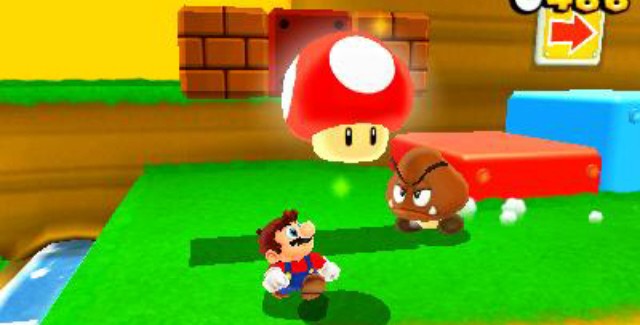
Visually, Mario 3D Land is highly impressive. It makes fantastic use of the 3-D effect. The 3-D not only adds visual depth to the environments, but also aids in platforming, making it much easier to judge distances and see the exact positions of objects on screen. The environments themselves are just as colorful and surreal as we’ve come to expect and they’re a joy to look at in 3-D. The music is also exactly what you would expect: bright, cheery tunes and remixes of that same classic theme that will never get old. Not much more to say, really.

Well, now, it’s time to discuss gameplay. What’s really interesting about Mario 3D Land is that even though it offers a three-dimensional playing field, it plays and feels just like a classic 2-D Mario game. Rather than having a life meter, Mario once again shrinks down to size when hit and one more hit will kill him. The game has a run button like in the classics, and power-ups also work the same way that they did in the old games. They function as an extra hit point as well as giving Mario a new ability. And speaking of power-ups, the tanuki suit returns, as advertised, allowing Mario to hover in the air for a short time and do a tail attack. There is also a new power-up: the Boomerang Suit, which, well…allows Mario to throw boomerangs. It’s pretty useful not only for defeating enemies but for collecting coins and Star Medals, which are collectibles that open up extra levels. In addition, the propeller block returns from New Super Mario Bros. Wii, launching Mario up into the air a short distance and allowing him to slowly descend.

The style of level design in Mario 3D Land is also reminiscent of the classics, being a lot simpler and more compact than that of its console-based older brothers. However, that’s not necessarily a bad thing. While the level designs are simple and compact, the creativity and wackiness of the Galaxy titles are still here in spades with the simplicity (alongside the other classic elements of the game) serving to add a sort of “back to basics” feel to it. The level designs are overall just as creative, diverse, and most importantly, fun as we have come to expect from the series and are the main reason why it’s such an amazing game. The levels are ridiculously enjoyable to play, and that’s not even going into all of the secrets they hold. Amazing stuff.

Now, it is worth noting that the main mode of Super Mario 3D Land is pretty short. It will likely take about two days to complete at best. However, upon completing the main story, you will actually unlock an extra set of eight worlds called Special Worlds. These worlds are mostly remixes of the previous levels that focus on a certain gimmick or make you complete it in a short amount of time, although there are a few all-new levels. There are also several levels in which you are chased by a shadow version of Mario that copies all of your actions, and you’ll take damage if it catches up to you. A lot of the levels of the Special Worlds are actually really difficult, especially toward the end, and playing through them will add a lot of longevity to the experience and ensure that the game will be well worth the price.

There is only one problem I have with Super Mario 3D Land: the lack of boss variety. I don’t mind this much with Bowser himself since, well, fights against him tend to play out similarly each time no matter what game you’re playing. My problem lies with the mini-bosses. There are only two different mini-bosses: a Koopa that spins around like a top and a Koopa that attacks you with her boomerang. Things really don’t change much between fights and they’re really easy to defeat besides. Sometimes the arena will be different, but that generally doesn’t do much to make things more difficult. At least with Bowser, it gets significantly harder each time you fight him. It’s not a severe problem, but it is there.

The Good:

+ Great visuals
+ 3D effect works great
+ Classic elements work for it
+ Level designs are brilliant
+ Plenty of secrets
+ Special Worlds add longevity to the game

The Bad:

- Mini-bosses are too easy and fought the same way each time

----------------------------------

After all is said and done, Super Mario 3D Land is yet another masterpiece starring the fat, red-and-blue-clad plumber. It’s pure platforming joy throughout its entire duration and I would actually call it one of my favorite Mario games. It’s easily the best game on 3DS right now and I would even say it’s the main reason to own one at the moment. It’s absolute bliss and I highly recommend. With all that said, see ya later.


Grade: A

Thursday, March 8, 2012

Kingdom Hearts 10th Anniversary Reviews: Re:Chain of Memories

-------My Rating System-------


A(-)(+) A top notch experience all the way through. It may not necessarily be perfect, but whatever flaws it does have won’t take you out of it or make it any less worth your time. (Super Mario Galaxy 1 and 2)


B(-)(+) A very fun experience bogged down by some significant problems, whether they’re related to the story, gameplay, or both. However, it’s still a good or even great game and worth the price of admission. (Kingdom Hearts: Recoded)


C(-)(+) A mixed bag. Generally fun to some extent and may shine in some areas, but is either too flawed to fully recommend or far too short for its price. Conisder it for a reduced price, at least if you’re a fan of its genre. (Rayman 3D)


D(-)(+) Subpar. It may not be terrible, but it is severely flawed and whatever it does well ultimately fails to save it. Even if you’re a fan of the genre, this is barely a bargain bin purchase. (Sonic Heroes)


F Insipid, disgusting, despicable, and insufferable. It is a scar on the face of human accomplishments that time shall never heal. The best thing we can do is avoid playing it at all costs. It is the only way to prevent its parasitic disease of awfulness from spreading. (Shadow the Hedgehog)


----------------------------------


And so our excursion through the Kingdom Hearts franchise continues. Today, we’ll be looking at the second installment in the series, Kingdom Hearts: Chain of Memories – or rather, its remake for the PS2, titled Re:Chain of Memories. Chain of Memories was originally released in 2004 for the Game Boy Advance as the first side game in the series, its storyline bridging the gap between Kingdom Hearts and the then-upcoming Kingdom Hearts II. However, in 2007, Square released a deluxe version of Kingdom Hearts II known as Final Mix+, which was bundled with a 3-D remake of this game complete with fully-voiced cutscenes as well as new cutscenes and boss fights. This remake was released as a standalone title in America a year later. It’s the definitive version of the game and thus the only one anyone should play, so I figured I would review it instead of the original.

Anyway, (Re:)Chain of Memories is viewed as the black sheep of the franchise for a few reasons. Most notably, it changes the combat gameplay completely as well as how you progress through the Disney worlds. However, it is a very important title to the franchise. It is at this point where the series started becoming much more than a crossover and began fleshing its own universe out more and more, introducing a group of mysterious villains whose origins and ultimate goals we wouldn’t understand until the next game. Many events of this game will also end up being fairly important to the series continuity, particularly where Kingdom Hearts II is concerned. So, with all that said, let’s dive in.

---------------------------

(The below paragraph will contain spoilers for the original Kingdom Hearts.)

Re:Chain of Memories takes place directly where the original left off. Sora, Donald and Goofy are still on the search for Riku and King Mickey, who had to be left behind when the Door to Darkness was closed. One night, Sora wakes up to find a mysterious figure in a black cloak prowling around who tells him that something he needs lies ahead, but he’ll have to lose something he holds dear to claim it. He follows the figure to Castle Oblivion, where the gang is convinced that they’ll find their friends. In Castle Oblivion, everything is governed by cards, from battling to progressing through the place. The castle itself actually uses Sora’s memories to recreate the areas he’s visited and the people he’s met. However, as the group progresses through the castle, they realize that they’re also losing memories bit by bit. As he forgets other things, Sora also starts gaining more and more memories of a blonde-haired girl he believed he used to hang out with on his island alongside Riku and Kairi before she suddenly left. All the while, they tangle with a mysterious group of black-cloaked villains calling themselves the “Organization”, whose intentions are unclear. Riku actually gets his own playable storyline as well, which you unlock after completing Sora’s, though giving details to that may spoil some elements of Sora’s storyline.

The storyline is…the main reason why you should play this game. Not just because it will help you understand Kingdom Hearts II’s plot, but because it is simply fantastic. For one thing, the villains are awesome. They’re mysterious, they’re cool, they have awesome weapons and they find fresh new ways to make you love to hate them all the time. The main characters are strong, as usual, and the pacing is perfect; each cutscene serves to advance to the main plot in some way. The main plot, as a whole, is really interesting and engaging, and there are some really nice plot twists as well. Overall, it can’t be described any other way than brilliant.

Of course, that’s not to say that everything is quite perfect on the story front either. All of the cutscenes are pre-rendered, meaning that unlike in most other installments in the series, lip movements are synced to the Japanese voice track rather than the English one. The voice acting takes a bit of a hit because of it. While the cast is still strong, characters often randomly pause during dialogue and line delivery sometimes feels a little out of place in the context of the scene. I also couldn’t help but feel like Haley Joel Osment wasn’t putting as much effort into his performance as in previous games and Donald’s pronunciation was weirdly awkward – even moreso than usual. Re:Chain of Memories also suffers from what I like to call “Final Fantasy X syndrome” – that is, the storyline is great, but the script is quite the opposite. It’s really unfortunate, because the previous installment (chronologically, anyway) averted it pretty well. To be fair, as far as Sora’s storyline is concerned, it’s a fairly mild case. The writing is inoffensive most of the time, but dialogue at some points made the main cast come off as idiots and I couldn’t help but feel like a several lines, while not cringe worthy, were a little cheesy. Things do get quite a bit worse in Riku’s storyline. The Kingdom Hearts series is already kind of known for its love of the word “darkness”, but Riku’s storyline takes it way too far even by the series standards. “Darkness” suddenly becomes everyone’s favorite word, and they just don’t shut up about it. It gets…kind of annoying, to say the least. And apparently, Riku can literally smell darkness and actually comments on the scent of every character he meets. I…really couldn’t get over this. I mean, what? Well, anyway, let’s move on, shall we?


The gameplay of Re:Chain of Memories is completely different from that of any other installment in the franchise – well, except for the original GBA verison of the game, of course. This different gameplay style has, of course, led to mixed reactions from fans. Personally, I find the gameplay of Re:Chain of Memories pretty solid and unique, though it isn’t quite as fun as the normal Kingdom Hearts gameplay. Let’s start with world navigation. In Re:Chain of Memories, you’re going to be revisiting all of the same worlds from the first game. No, you won’t see any brand-new Disney worlds here, but reusing the old ones does work for the plot and there is a twist. Rather than progressing from room to room like you would in any other game in the series, you actually create the rooms yourself...well, sort of. Separating you from the other rooms are doors which require a Map Card – which you will get by winning battles – with a certain number on it to open. The type of a map card you use directly affects the layout. The size of a room, the number of Heartless you find in it and even the types of Heartless you find in it are all dictated by what map card you used, though what you will find in a given room will also be affected by what world you’re in. It’s also by using map cards that you will find save points and Moogle shops. Some map cards even affect other things. In a Stagnant Space room, for instance, all Heartless will move slowly, which allows you to avoid battles more easily. It’s very unique and does add a new element of strategy to the game; however, there is a flaw here: none of the rooms are terribly interesting. There are just some Heartless to battle and some things to hit or jump on for money, health and the occasional card. There really isn’t much substantial exploration to be found in this game, which, when compared to the first Kingdom Hearts, does prove a bit disappointing.

Then there’s the card-based battle system, which is probably the most polarizing aspect of the game. It’s a real-time battle system where every action you and your enemies take requires a card to use. You have attack cards, magic cards, and item cards. There are also enemy cards, which give you attributes such as a wider attack range or making certain cards unbreakable. There are also friend cards that allow you to summon Donald, Goofy, or another Disney character, which will randomly appear during battle. Each card has a number on it, which affects what will happen if you use a card at the same time an enemy does. If the value of your card is higher than that of the enemy’s, the enemy’s card will be broken and it will be stunned, and vice versa if the value of your card is lower. If the value of both cards is the same, nothing will happen – unless you’re playing Riku’s storyline, that is, but I’ll get to that later. Cards numbered “0” work differently. They can break any card, but can be broken just as quickly by any card of a higher value. You can also stock up to three cards by pressing the triangle button, and the value of your attack at that point is the combined values of the three cards you used, making it very hard to break. Stocking cards of certain values or types is also how you will use special moves such as the Blitz or Strike Raid. Cards can be reloaded, but if you stocked cards, the first one you stocked will always be gone for good. You can customize your deck of cards through the menu using whatever cards you’ve found or bought at Moogle shops. However, putting a card in your deck will cost Card Points, of which you have a certain number, and the cost of putting a card in your deck varies. You can raise your Card Points when you level up.

Well, let’s weigh the pros and cons here, starting with the pros. Aside from just being really unique and creative, it’s very strategic. You have to think about what cards to use and when, as well as when to stock cards and even what order cards should be stocked in. You also have to think when building a deck about exactly what cards will be useful for your situation. Building a deck also adds a very substantial element of character customization to the mix. However, while all this is great, it comes at the expense of being a lot more limiting than the usual battle system. Your combo can only have up to three hits and you can’t upgrade it, and the limitations on building your deck essentially means you can only have a limited number of moves before you have to reload, which will take longer each time you do it. Using special moves isn’t simply a matter of having enough magic power; you have to have the right cards on hand and, as said before, the first card you stocked to use that move is gone for good, and you can’t use it for anything else unless you happen to have a Hi-Potion or Mega-Potion card on hand – and those cost a lot of CP. And generally, the battle system is much slower-paced than that of Kingdom Hearts I and II and battles tend to take a little longer to finish. So, while it is fun enough, it’s not quite as much fun as the original battle system. I’d say that the times I most enjoyed it were during the battles with the Organization members. I always felt like I was facing off with my equal (on Proud Mode, anyway), which made it that much more satisfying to win. That is some dang good AI.

When playing as Riku, things are a bit different. By breaking cards, you gain points. If you gain enough of points, Riku can go into Dark Mode, during whichhis attacks become much faster and more powerful. Each world also gives you a preset deck of cards of varying values that you can’t change. However, you can use this to your advantage. If you use a card of the same value as an enemy, you will get into a card battle, at which point you have to break several of an enemy’s cards within a certain time limit. If you successfully do so, then you can use a devastating special move. Reloading Riku’s cards is also much faster than reloading Sora’s; just press “X” when you run out and you will get all of your cards back. Essentially, Riku’s story is a mode you can just breeze through after playing through the game normally as Sora, and you feel totally awesome doing it. However, don’t think that Riku’s storyline removes any semblance of challenge. Having cards of random values puts you in as much danger of having your cards broken as your enemies, and getting your cards broken will actually cause you to lose points. In addition, during card battles, you will be required to use your strongest cards to break the enemy’s and reloading can still waste a lot of time. If you aren’t able to break all of an enemy’s cards before time runs out, you will be stunned for quite a while. Whatever the case, I did enjoy playing as Riku more than I did playing as Sora.

In terms of aesthetics, Re:Chain of Memories fares reasonably well. During normal gameplay, it looks…alright. The worlds are pretty bland, I have to say. Most of the character models are also reused from the original Kingdom Hearts, perhaps touched up a bit, but they still look pretty nice. The cutscenes fare a lot better. The facial animations on display here are some of the best you will see in the series and the cutscenes overall look more cinematic than ever before. It is worth noting, though, that Re:CoM’s cutscenes are pre-rendered rather than in-engine like those of Kingdom Hearts I and II. The music is…mostly exactly the same as that of the first Kingdom Hearts with only a few original tracks. The original tracks are pretty great, though. While the new boss theme is pretty unremarkable, the themes for the final three areas are all very nice, and the Organization battle theme? Heck, when I played the GBA version as a kid, I actually got excited to fight the Organization members just because of that theme.

The Good:

+ Fantastic storyline
+ Two playable story modes
+ Map synthesis is unique
+ New music tracks are great
+ Cutscenes look very nice
+ Card-based battle system is unique and strategic…

The Bad:

- …Though at the same time more limiting and slower-paced
- Writing can get pretty mediocre
- Voice acting, while decent, doesn't live up to the series standard
- Areas aren't very interesting

------------------------------------

In the end, while it’s not up there with the series’ best, Re:Chain of Memories is a very good game. You should play it because of the storyline, if nothing else, and the gameplay is still fun. You probably won’t be rushing back to play this one, but it’s still worth a shot. Next time we play Kingdom Hearts, we’ll be looking at Kingdom Hearts II. See ya then.


Grade: B

Wednesday, February 29, 2012

Kingdom Hearts 10th Anniversary Reviews: Kingdom Hearts I

-------My Rating System-------


A(-)(+) A top notch experience all the way through. It may not necessarily be perfect, but whatever flaws it does have won’t take you out of it or make it any less worth your time. (Super Mario Galaxy 1 and 2)

B(-)(+) A very fun experience bogged down by some significant problems, whether they’re related to the story, gameplay, or both. However, it’s still a good or even great game and worth the price of admission. (Kingdom Hearts: Recoded)

C(-)(+) A mixed bag. Generally fun to some extent and may shine in some areas, but is either too flawed to fully recommend or far too short for its price. Conisder it for a reduced price, at least if you’re a fan of its genre. (Rayman 3D)

D(-)(+) Subpar. It may not be terrible, but it is severely flawed and whatever it does well ultimately fails to save it. Even if you’re a fan of the genre, this is barely a bargain bin purchase. (Sonic Heroes)

F Insipid, disgusting, despicable, and insufferable. It is a scar on the face of human accomplishments that time shall never heal. The best thing we can do is avoid playing it at all costs. It is the only way to prevent its parasitic disease of awfulness from spreading. (Shadow the Hedgehog)

-------------------------------


So, it seems it has been ten years already since Kingdom Hearts graced the world with its existence. Kingdom Hearts is a strange series by its very concept, and it’s even stranger how good it turned out to be. The series, developed by Square Enix, features you traveling between various worlds based on Disney movies – usually the animated ones, though we did end up getting worlds based on Tron and Pirates of the Caribbean – and all the while meeting up with various characters from Square’s own Final Fantasy series. While this sounds like a ridiculous idea on paper, the game proved to be immensely successful and has developed into a franchise that actually took on a life of its own, so to speak, with subsequent installments shifting the focus more and more onto the characters, concepts and mythology that solely exist within the Kingdom Hearts universe. The continuity itself has even started to reach Metal Gear Solid levels of convoluted as of Birth by Sleep, the latest main series game thus far.

And somehow, everything always seems to work. The crossover aspect of the series was handled expertly from the get-go. The more lighthearted elements of Disney and the darker, more melodramatic elements of Final Fantasy are handled in such a way that they never feel like they’re clashing too much, and are balanced out really well. The storylines are also very character-driven and even emotional, and the characters themselves are very likable. In addition, the events that transpire in the Disney worlds usually serve some sort of purpose for the main plot and the movies’ plots themselves are integrated into the main story quite nicely. Not to mention that these worlds are a nostalgia trip for anyone who grew up with Disney and the gameplay stuff is pretty sweet too. So, since this is such a great franchise, I’ve decided that in honor of its tenth anniversary, I am going to review each game in the series released thus far (except for Re:coded, since I already reviewed that), starting with the first. Without further ado, let’s see what the original Kingdom Hearts has in store for us.

---------------------------------------

Kingdom Hearts begins on Destiny Islands, where Sora, the main protagonist, and his best friends Riku and Kairi live among various Final Fantasy characters. Sora, Riku and Kairi all wonder if there are worlds beyond their own and, being stupid kids, decide to build a raft that they believe might take them to these other worlds. Unfortunately, one stormy night, Sora finds the islands under attack by dark creatures and he watches his best friends disappear before his very eyes. What’s more, during all this he receives a key-shaped weapon called the “Keyblade” that allows him to fight these creatures, known as Heartless, and he gets sucked into a black void, after which he wakes up in a new world known as “Traverse Town”. Meanwhile, Disney characters Donald and Goofy have set out in search of the king of their world – guess which Disney character that is – who has gone missing, which causes them to cross paths with Sora. They then decide to team up to search the universe for Riku, Kairi and the king, fighting Heartless and getting tangled up in the affairs of the Disney worlds along the way.

Though it’s not as complex as later plots in the series would be, the storyline of Kingdom Hearts is actually really good. I kind of already explained what makes the storyline so good in the introduction, so I see no need to repeat myself. However, there are a couple of other things that I think I should talk about: mostly, the voice acting. Kingdom Hearts was, as far as I know, Square’s first big game to come out after Final Fantasy X, which was…pretty weak in the area of voice acting, to say the least. In Kingdom Hearts, though, the voice acting is actually pretty exceptional. Notably, many of the same actors from the original Disney movies were used for the game – either them, or the actors from the direct-to-video sequels, but they do a pretty great job as well even if the sequels were utter tripe. Even if he’s no Robin Williams, Dan Castellaneta does a great job as the Genie, and aside from him, we’ve got James Woods as Hades, Scott Weinger as Aladdin and lots of other great actors and actresses. A lot of the actors for the non-Disney characters are also pretty famous – the main character is even voiced by Haley Joel Osment. I suppose that Riku and Squall are the worst ones, sounding pretty flat in comparison to the rest of the cast, but they’re still okay. Writing was another area in which Final Fantasy X failed, but Kingdom Hearts does a decent job there too - better than some later installments would, anyway, but we'll get to that when we get to it.

Kingdom Hearts also fares very well aesthetically. The visuals have actually aged surprisingly well, especially in the realm of facial animations…well, about half the time, anyway. A lot of times, facial animations are pretty simplistic, but during close-ups or particularly dramatic moments, the facial animations will look very expressive and detailed and Square actually synced the lip movements to the English voice track this time. Even when the facial animations look more simplistic, however, they still look a lot better than Final Fantasy X’s. The models for the Disney characters are another particularly impressive aspect of the visuals. They all look like they came straight out of the movies they were featured in. Considering the voice cast and the authentic-looking character models, you can really tell that the developers went the extra mile in making this a great tribute to Disney. And then there is the soundtrack, composed by Yoko Shimomura, and it is absolutely fantastic. The title screen theme, Dearly Beloved, is so good that you will not only hear it at the title screen of every Kingdom Hearts game ever but also in various forms throughout the games themselves. Battle themes are another highlight, especially the boss themes. Simple and Clean, the main vocal theme, is sung by Utada Hikaru and it’s also very nice. All in all, awesome stuff.

And now, we can finally discuss the gameplay, starting with the combat since a lot of what you will be doing in this game is fighting Heartless. Combat gameplay in Kingdom Hearts is pretty simple and reminiscent of hack-n-slashes. You’ve got a list of commands in the lower-left corner of the screen, one of which will usually be blank and is mostly used for interacting with the environment, that you scroll through using the right analogue stick and use by pressing the “X” button. These commands allow you to perform a physical attack, use magic, or use an item, and most of the time you’ll be using physical attacks.

The combat is simple and may come off as button mashing at first, but it really isn’t shallow. Using magic does a good job of mixing things up and up to three spells can even be assigned to certain buttons as shortcuts, which you then use by holding the L1 button down. Equipping items also adds an element of strategy, as do abilities, which you will receive as the game goes on. Many abilities add to combos or change certain moves and some even give you entirely new moves, such as rolling and blocking, and even devastating attacks that consume magic power. The amount of abilities you can have equipped at once are limited by your Ability Points and the amount of AP it takes to equip an ability varies, which adds an element of customization. There’s also some nice enemy variety; some enemies retreat into the ground or become vapor, preventing you from attacking until they appear again; some enemies can only be attacked from behind; some enemies fly; some use projectile attacks, etc. It’s a very fun combat system and later games would expand upon it, and on the subject of combat, boss fights prove to be a notable highlight. While the early ones will come off as a bit lackluster, things quickly get better once you make it to the world based on Disney’s Tarzan and only go uphill from there, being very memorable and enjoyable to fight and providing some nice challenges.

Outside of combat, you’ll be doing a lot of exploring with a bit of platforming thrown in. Some people seem to have a problem with the platforming of Kingdom Hearts. Actually, I don’t mind it. In fact, I think it gives it something interesting that the Final Fantasy series didn’t have: vertical exploration. Exploration in general is pretty rewarding; you’ll find lots of items and synthesis materials this way, as well as the 99 Dalmatian puppies from 101 Dalmatians, which are part of a side quest. Speaking of side quests, there are also plenty of those; there are several optional bosses and the world based on Disney’s Hercules features several battle tournaments, which are really fun. There are also the Trinity Marks and a few mini-games to waste your time with. Almost all of this stuff is optional, though, so if you don’t want to bother with it, you don’t have to, and fetch quests are very rare, so if the exploration doesn’t interest you and you just want to get on with the storyline, you can do that.

There’s one more notable aspect of the gameplay: the Gummi Ship. The Gummi Ship is your method of traveling between worlds. Not long into the game, you get an upgrade that allows you to warp to worlds you’ve already visited, but the first time you go to each world, you will have to play through a short rail shooting course. It’s really simplistic and not very difficult at all, which does make it the weakest aspect of the game. However, there is some fun to it. As you explore the worlds, you will find “gummis” that you can use to build on to your ship and you can even buy them from Cid (the one from Final Fantasy VII). There are armor gummis, weapon gummis, wing gummis and many more that you’ll run upon. Use them wisely, and you can turn your Gummi Ship into an absolute powerhouse. At that point, going through the rail shooting areas and annihilating everything is just plain satisfying. The Gummi Ship is nothing great, but it’s a nice little distraction.

There are only a couple of problems that I had with Kingdom Hearts. First of all, just like in Final Fantasy X, you can never skip cutscenes before boss fights. However, I really don’t have nearly as much of a problem with this here as I do in that game. Cutscenes in Kingdom Hearts aren’t nearly as long as those in Final Fantasy X, which makes repeating the bosses less frustrating, and the bosses themselves aren’t as difficult, meaning you probably won’t be repeating them nearly as often. It’s a frustration, but not a gigantic one. My other problem is with the world based on The Little Mermaid. When compared to the other worlds, it felt needlessly huge and tedious to navigate and combat wasn’t as much fun either since movement was in three dimensions, the world being completely submerged and all, which meant that you had to take your position relative to the enemy’s into account more. I also couldn’t help but think that combat felt a lot slower. It’s easily the lowest point of an otherwise fantastic game. Sigh…why do water levels almost always suck?

The Good:

+ Great storyline and characters
+ Great voice acting
+ Crossover aspect is handled very well
+ Visuals have aged surprisingly well
+ Fantastic soundtrack
+ Fun combat system
+ Great boss fights
+ Exploration is rewarding
+ Plenty of side quests

The Bad:

- Cutscenes are unskippable
- The Little Mermaid world is a bit of a slog

------------------------------------

So now the first chapter of our journey through the Kingdom Hearts series has come to a close, and it was a really fantastic one at that. For a game with such a strange concept, it fared extremely well, especially where the storyline is concerned. It has aged superbly and I wholeheartedly recommend it. Next time we tackle this series, we’ll be looking at Re:Chain of Memories, the game that ties Kingdom Hearts I and II together – or rather, the PS2 remake of the game that ties Kingdom Hearts I and II together. Stay tuned.


Grade: A-

Wednesday, February 22, 2012

Pre-Emptive Strike: Final Fantasy XIII-2


You know, I really don’t consider myself very difficult to please when it comes to video games. I know what mediocrity is, but I tend to enjoy several games that many people hate. Sonic the Hedgehog 4: Episode I and Metroid: Other M, though they did receive fairly decent critical reviews, are both utterly despised by their respective series’ fanbases, and while I can admit that they have their flaws, I enjoyed both games a lot. And, for my money, Final Fantasy XIII is brilliant with a fantastic storyline and a great combat system. However, while I love Final Fantasy XIII, I can admit that the criticisms toward it are valid and I appreciated the fact that Square intended to address those criticisms in the direct sequel, Final Fantasy XIII-2, which I decided to set aside sixty dollars to buy. However, after spending ten hours with it, well…let’s just say that my thoughts may surprise you.

(Yes, these are my impressions after only playing ten hours of the game, which is why I’m calling this a “pre-emptive strike” and not a proper “review”. Mainly, I’m not sure if I’m going to finish this game very soon since I have quite a few other games I want to play at the moment, so I wanted to go ahead and get my thoughts out there. If I finish the game and my thoughts change on anything, I will write an amended review.)

-----------------------------------------

(The below paragraph contains spoilers for Final Fantasy XIII.)

The storyline of Final Fantasy XIII-2 focuses on Serah, the younger sister of the first game’s main character, Lightning. While Final Fantasy XIII ended on a high note, in XIII-2, a time paradox has caused Lightning to be written out of said ending and instead has caused her to be thrown into a battle with Caius to protect the goddess Etro. Serah, somehow, is the only one who remembers Lightning being in the ending, though everyone tells her it’s just a dream. Just in time, a boy from an apocalyptic future named Noel rides a giant meteor into Serah’s time with a shape-shifting Moogle in tow. Meanwhile, time paradoxes are rapidly occurring everywhere, and Serah and Noel set out on an epic time-traveling adventure to save the world.

Sigh…well, that’s the basic gist of it. Well, where to begin? How bout that it revolves around an obnoxious retcon to a perfectly good ending? I liked the ending to XIII and I thought it was a really satisfying conclusion! XIII-2 decides to take a gigantic dump on that. And then there are the characters. I thought XIII’s characters were great; I found the cast to be really likable and I enjoyed watching them interact and develop. In XIII-2, however, the only character I find even mildly interesting or likable is Noel. Serah is completely vapid and almost devoid of any sort of real personality. Almost all she does is whine and monologue about how she misses Lightning and wants to see her again. Heck, upon meeting back up with her fiancĂ©e, Snow, after not having seen him in over three years, she almost seems to not care. Then there’s your Moogle partner, Mog, who, let me just say, will have you running back to Navi in an instant. With every joyful shout of “kupo”, you can tell the game is absolutely BEGGING you to find him absolutely cuddly-wuddly adorable, but it just comes off as incredibly annoying and his voice doesn’t help either. Alyssa’s over-enthusiasm and general stupidity make it impossible for me to feel anything other than hatred for her, and finally – ugh – there’s Chocolina, the merchant who sells you things. Let me just say that this chick has to be one of the most utterly irritating, unnecessary, horribly written and downright awful characters in any JRPG ever. Even the sound of her voice is enough to set me off. Even aside from those flaws, the storyline so far just feels like it’s built on a collection of bad ideas that serve no purpose other than to make me roll my eyes.

But, of course, the storyline isn’t the most important aspect of a game. That would be the gameplay. But hey, you know what? They screwed that up, too. You know, I was fine with the linearity of XIII. I thought it worked from a storytelling perspective. That said, a lot of people hated it – a lot – and one of Square’s main goals for XIII-2 was to make a more exploration-oriented experience, and, well, while I suppose the game has some “exploration”, none of it feels substantial. The game’s areas from what I’ve played are either collections of straight lines, a single wide straight line with two or three areas branching off that lead to an item or two, or a needlessly large area with precious little to do in it. If someone at Square was feeling really crazy that day, you might actually be required to backtrack once or twice across this world of straight lines. Sorry, Square, but this is not exploration, nor is it at all fun.

Occasionally, you will be given a puzzle or an optional side quest to divert your attention, but these are just as laughably insubstantial as the environments. All of the puzzles so far have been laughably easy, essentially being “connect the dots” with a side of shape and color matching. I don’t know about anyone else, but I went to kindergarten and I don’t think I need Final Fantasy XIII-2 to put me through it again. Then there are the “side quests”, which are essentially tedious, boring fetch quests that make the Tears of Light quests from Twilight Princess look engaging. Yes, you could say that I’m judging these aspects too soon since I have only played ten hours, but hey, let’s be honest, that’s ten freaking hours! This game should really have picked up by now.

Oh, and another thing. Neither Final Fantasy XII nor XIII featured random encounters, which is something that I greatly appreciated. Final Fantasy XIII-2 brings them back. No, as a matter of fact, I am not kidding. Rather than there being a transition between traversing the overworld and fighting a battle, now enemies actually spawn on top of you. While this does give you more of a chance to get away, at the same time it happens a lot more frequently, is twice as obnoxious, and leads to much frustration when you’re trying to “explore”. On top of that, I just cannot for the life of me understand why. Why would you break what you just fixed? Why?! Oh, and there are no new enemies from XIII at all. They’re all exactly the same, right down to the design. Unnacceptable.

Heck, even the aesthetics of Final Fantasy XIII-2 seem worse than those of the first. The look of the game itself is almost on par with the first, but the framerate is completely, inexcusably choppy. And then there’s the soundtrack. XIII-2 offers a more vocal-based soundtrack than previous Final Fantasy games. I’m all for that, but unfortunately, very few of this game’s tracks are even listenable, and even the ones that are listenable aren’t very memorable.

Fortunately, not everything is terrible in Final Fantasy XIII-2. The battle system, much like it was in XIII, is still really fun. If you want an explanation as to how it works, you can check out my review of XIII, but anyway, it’s just as fun and fast-paced as it was before…well, in my opinion at least. A lot of people even hated the battle system of Final Fantasy XIII, so I have to say, if you weren’t a fan of it in the first place, I doubt you will care much for it here either. There have been some changes to it – namely, that you can switch your party leader (and the leader will automatically switch if the character you’re controlling dies) and it features quick time events, but I wouldn’t say that these changes are too substantial. In short, if you loved the battle system in the first game, you’ll love it here, but if not, XIII-2 won’t do anything to change your mind. Another positive aspect of XIII-2 is the Live Trigger, which allows you to choose exactly what a character says at certain points and I believe you can even get different items depending on your choices. It’s not too substantial, but I do enjoy it.

The Good:

+ Live Trigger is nice
+ Battle system is still fun

The Bad:

- Exploration is really insubstantial
- Puzzles are insultingly easy
- “Side quests” are just boring fetch quests
- Random encounters return
- Storyline and characters are awful

---------------------------------------

Yes, I’ll admit that it’s unfair to judge a game before I finish it, but I really did give it a chance, and if it takes more than ten hours for a game to become even passable…that’s pretty hard to forgive as well. I would have played more of it before writing this, but honestly, I’ve got much better games on my mind right now. Heck, I’m actually playing through and reviewing all of the games in the Kingdom Hearts series in honor of its tenth anniversary. If I do come back to the game and finish it, my thoughts may change, but these are my impressions for the moment.

Pre-Emptive Grade: D

Saturday, February 11, 2012

Retro Review: Final Fantasy X

-------My Rating System-------

A(-)(+) A top notch experience all the way through. It may not necessarily be perfect, but whatever flaws it does have won’t take you out of it or make it any less worth your time. (Super Mario Galaxy 1 and 2)

B(-)(+) A very fun experience bogged down by some significant problems, whether they’re related to the story, gameplay, or both. However, it’s still a good or even great game and worth the price of admission. (Kingdom Hearts: Recoded)

C(-)(+) A mixed bag. Generally fun to some extent and may shine in some areas, but is either too flawed to fully recommend or far too short for its price. Conisder it for a reduced price, at least if you’re a fan of its genre. (Rayman 3D)

D(-)(+) Subpar. It may not be terrible, but it is severely flawed and whatever it does well ultimately fails to save it. Even if you’re a fan of the genre, this is barely a bargain bin purchase. (Sonic Heroes)

F Insipid, disgusting, despicable, and insufferable. It is a scar on the face of human accomplishments that time shall never heal. The best thing we can do is avoid playing it at all costs. It is the only way to prevent its parasitic disease of awfulness from spreading. (Shadow the Hedgehog)


--------------------------------------------


Last fall, I reviewed Final Fantasy XIII for the Xbox 360 and PS3. It’s a very underrated game in my opinion and I think it deserves more credit than it gets. (The direct sequel actually came out just a few weeks ago, and I’ll probably be reviewing that at some point as well.) Playing through it actually rekindled my interest in the series and I've found myself playing the games more often, and one of the games that I was actually very interested in was the tenth installment on PlayStation 2. Though I never beat it, I liked it a lot as a kid and I have a bit of nostalgia for it - well, the first ten hours anyway. This is, after all, a retro review, so I can't be wearing nostalgia goggles. It also was the first Final Fantasy game to feature full voice acting and broke a lot of other series traditions as well, such as having more linear progression among other interesting things, which I will get to when the review officially starts. Oh, and apparently it’s getting an HD remake in honor of its tenth anniversary, so there’s that. I was going to wait to play it again until the port came out, but due to my impatience and reluctance to buy an upgraded version of a game I already own for full price, I found myself playing through the game on PS2. So, now that I’ve finished it, let’s see how it holds up.

-----------------------------------------

Visually, Final Fantasy X is a mixed bag. In some ways, it’s aged surprisingly well, while in others, it’s…kind of laughable. To start with, the environments actually look really great to this very day. There’s quite a bit to look at, and it’s all really beautiful, particularly in the lush forest environments. Cinematic sequences are simply amazing and show off some really impressive production values and art direction. All of the most memorable and spectacular moments of the game’s storyline will take place during these sequences, and the character models for the main cast and monsters, especially animation-wise, look pretty impressive given the time. Beyond that, though, things don’t fare so well. Character models for most side characters are really blocky and lazily put together and facial animations, even for the main cast, are ridiculously hit or miss – usually miss. Rarely, they’ll actually look really natural and expressive. Sometimes they’ll look really mediocre, sometimes they’ll look downright creepy, and almost half the time they’ll look laughably bad. This is easy to forgive since it is, of course, an old game, but at the same time hard to ignore. Musically, though, things fare a lot better, and why wouldn’t it? It’s Nobuo Uematsu, after all. Nothing else needs to be said.


Moving on to matters of importance, let’s discuss the gameplay. Gameplay-wise, Final Fantasy X is quite a big departure from previous games in the series in three main ways: its lack of an exploration-encouraging overworld map, having a different character growth system and having a brand-new battle system. The battle system is probably the most interesting of these differences. At first glance, it may not seem much different from the ATB system used from IV through IX. It’s still turn-based and plays similarly in that, upon a character’s turn, a command list is brought up that gives you a list of options that determines that character’s actions such as using a normal attack, using a special move, using a skill, using white or black magic, or using an item. However, the ATB gauge is gone for both you and your enemies; things keep moving and there’s no waiting involved, which makes battles much faster. When a character or enemy takes his or her turn is determined by a variety of factors and can be affected by using different commands or even attacks and spells. While such spells as Haste and Slow sped up and slowed down the ATB gauge (respectively) in games past, now they give characters and enemies extra turns or make them wait longer to take their turn, and such moves as Quick Hit and Delay Attack also affect who takes their turn and when. In the upper-right corner of the screen, there is actually a box that displays the turn order and actually allows you to plan your moves around it.


You can only take three characters into a battle at once, but they can be switched out at any time, a feature which you will be making use of a lot. This is because all of the characters have different uses in battle. There are seven characters that you will be controlling – Tidus, Auron, Rikku, Wakka, Lulu, Yuna, and Kimahri. Tidus, Auron, Wakka and Kimahri are all effective physical attackers, but have specific uses. Auron can effectively do damage to armored enemies with his giant sword and can learn attacks that weaken the enemy, Wakka can attack flying enemies since his weapon is a ball (no, I am not kidding) and learn attacks that cause status ailments, Tidus can learn helpful spells such as Haste and Slow, and Kimahri can learn enemy abilities with his “Lancet” move. Rikku can steal items from enemies and then use said items against them or to aid the party, Lulu is your black mage, and Yuna is your white mage and summoner. Speaking of which, unlike in previous games where summoned monsters used a single attack and then flew away, you can actually control them like normal characters this time around and they come complete with their own sets of skills and limit breaks (or overdrives, as it were). Overall, the battle system is really fun and strategic and one of the game’s highlights.

As for the character development system, it’s pretty interesting as well. As you fight battles, characters gain “sphere levels”, or points to use on the upgrade board known as the Sphere Grid. Each sphere level allows you to move one space on the grid. If any spaces nearby house upgrades to any of your stats or even an ability or magic spell, you can use a different sphere like a “Power Sphere” or an “Ability Sphere” to unlock it. Sphere levels are gained pretty quickly, which allows you to get upgrades more quickly. I liked this upgrade system quite a bit. However, I did find that Final Fantasy XIII’s Crystarium was a better handling of the “upgrade board” idea for a couple of reasons. Mostly, the Sphere Grid…really doesn’t do much to make grinding easier. XIII only gave you the essential stats to deal with: strength, HP, magic power and defense. You didn’t even need to upgrade your magic points since those were infinite in that game. In Final Fantasy X, you’re looking at a lot of different stats aside from those: speed, agility, evasion, magic defense, MP, and even luck. A lot of spaces on the grid are even completely blank and useless unless you have a type of sphere that will turn them into useful ones. When I’m grinding, speed, agility, evasion and luck, while nice stats to upgrade, just seem like roadblocks on the way to the stats I really need upgraded. The fact that it’s simpler and faster to use also made me prefer the Crystarium. But like I said, even if the series has handled the upgrade board idea better since X, the Sphere Grid is pretty nice.

Then there’s the lack of an overworld map, which is something I’m sure a lot of longtime fans didn’t really appreciate, especially given that it adds a more linear progression to it. Like XIII, I thought this worked for X from a storytelling perspective. However, it is worth noting that despite its general linearity, X does admittedly offer more to do than XIII. There are a few areas and towns that encourage a little bit of exploration for treasures and whatnot, and there are plenty of mini-games and optional side quests to distract you along the way. The most prominent mini-game in Final Fantasy X is blitzball, likely meant to be the game’s own “Triple Triad” or “Tetra Master” except for the fact that it doesn’t involve cards. However, I have to say, it didn’t appeal to me. I just found it to be pretty boring and didn’t spend much time with it. Thankfully, it’s completely optional aside from a single area in the game. It wasn’t for me, but if you enjoy it I’d say you would be able to spend hours with it. Lord knows how much time I’ve wasted playing Tetra Master in Final Fantasy IX... There are also several puzzle-solving areas in Final Fantasy X known as “Cloisters of Trials”, which are actually pretty fun and interesting if a bit tedious. They’re focused on moving around spheres, which have varying effects on the environment, so that you can open up paths to the end. Like I said, they can get tedious, but I did enjoy them quite a bit in spite of that.

Oh yeah, there’s one last thing that I need to mention here: Final Fantasy X, like all Final Fantasy games before it, uses random encounters and was actually the last one to do so. I mentioned in my review of XIII that the random encounters were my main problem with the series, but after playing a lot of the older games, I’ve gotten pretty desensitized to them. In fact, I’d say X’s linear progression lends itself to them better than any Final Fantasy before it. What annoyed me about them in the past was their apparent frequency combined with the fact that they felt disruptive to me, which made exploration less fun. X doesn’t feature as much exploration and, as such, the random encounters aren’t as troublesome. I’d say that if they really bother you, this could affect your decision to play the game, but I’d say I’m okay with ‘em here.


With all gameplay-related discussion out of the way, let’s talk story, one of the most important aspects of any JRPG. The main character of the game is Tidus, who is transported from his home in the futuristic city of Zanarkand to the future world of Spira when a monster named Sin attacks. After waking up in Spira, he finds himself constantly assaulted by monsters known as “fiends”. He receives help from a young girl named Rikku who explains, after being told that he is from Zanarkand, that said city was destroyed by Sin a thousand years ago. Sin attacks again and leaves Tidus on the shore of the island country of Besaid, where he meets Wakka, Lulu and Yuna, a summoner whose job it is to defeat Sin, and begins to learn the ropes and history of this new and unfamiliar world as he accompanies Yuna on her pilgrimage to each of Spira’s temples to receive the aeon, or summon monster, which she will use to defeat Sin. Much of the story, in fact, focuses on Tidus’ relationship with and thoughts on the world and the people around him.

Actually, I think that this was a very interesting type of story for a Final Fantasy game or even a JRPG in general to tell. For Final Fantasy X, we are given a main protagonist that knows as little about the world as we do, and most of the story is even told in flashback. This makes the world more mysterious and a lot more interesting to learn about than it would be otherwise, and Tidus’ narration also adds to it by giving a lot more insight as to his thoughts and feelings about the various situations he and his group encounter along the way. The setting is also very unique and the various ways that the world of Spira works, its constant struggles with the seemingly unstoppable Sin – who, if defeated by a summoner, will still come back after a few years – and the general tone of the game all make Spira feel very tragic at the same time that it is beautiful and surreal. The progression of the plot also, intentionally or not, gave me a sort of “road movie” vibe a lot of times, because, essentially, you’re making a trip around the world to visit several places throughout Spira and dealing with the various hardships along the way, which was another thing I found really interesting. On the whole, the plot of Final Fantasy X is really good. Though I would expect no less from Final Fantasy, the unique setting and feel do give it something interesting over the other installments.

However, with all that said, there are some really significant things holding the story back, one of them being the characters. I don’t mean that the characters weren’t likable so much as that most of them felt really underdeveloped and like they were just along for the ride. Tidus, Yuna and Auron were the only characters that the story gave me any real reason to care about. The rest of the cast receives little development and if they do, it’s minor. While they have their back stories, they’re not really compelling or even touched on all that much. It felt to me like they were there for plot and gameplay necessity rather than actually adding something to the plot. Why is Rikku there? Because the main party needed a representative of the Al Bhed race. Why is Wakka there? Because Tidus needed someone to teach him about Spira. Why is Lulu there? Because the game needed a black mage. Why is Kimahri there? Because the main party needed a representative of the Ronso race. All of these characters could and should have been compelling, and it feels like lazy writing to me that more effort wasn’t taken to make them so.

And speaking of the writing, even aside from that it’s not very good. It’s inoffensive about half the time, but when it comes to the other half, lines can range from bad to outright cringeworthy. At its absolute worst, it makes Sonic Adventure look like Inception. That’s…kind of an accomplishment. Voice acting doesn’t fare much better.The only consistently good actors for the main characters are the ones for Rikku and Wakka. Lulu and Auron are alright, I suppose, though they definitely have their moments. Yuna’s speech is filled with awkward and seemingly random pauses and her delivery can be pretty wooden, and while Tidus’ actor is certainly talented – he is Ratchet, after all - his delivery almost never fit the context of the scene, which is probably the product of bad voice direction more than anything else. Kimahri’s voice is utterly wooden, and I doubt the broken English they wrote in the script and called his “lines” helped much. I mean, seriously, why do almost all of the Ronso in the game talk like that? Why didn’t they just give them their own language like they did with the Al Bhed? Well, anyway, side characters…actually fared a lot better than the main ones, with some ear-grating exceptions of course. If I hear the shoopuf driver one more time…


While not story related, I do have one more problem with this game, and it’s a pretty big one: you can never skip the cutscenes. This was a massive frustration. The bosses in this game can get pretty difficult, which is fine. However, many of them are preceded by lengthy cutscenes – all of which you will be forced to watch again should you fail. If you’re lucky enough, you can press “X” through some of the dialogue, but sometimes it wouldn’t even let you do that. Naturally, you aren’t allowed to skip any of the dialogue in the long cutscene before the final boss – and I mean ANY of it – and, of course, that is the hardest and most frustrating non-optional boss in the game. Actually, the part right before the final boss was plagued with enough bad design as it was. Right before the really long, unskippable cutscene, you had to, for no apparent reason other than to cause unnecessary annoyance, collect ten crystals in a room with a horrible and potentially nauseating rotating camera and, to add insult to injury, spiked icicles constantly blasting out of the floor under you and initiating an enemy encounter if it trips you up. And no, you can’t save directly afterwards, meaning that if you die at the final boss, you not only have to watch the entire pre-battle cutscene again, but you also have to collect ten crystals in a room with a horrible camera and battle-initiating icicles. I simply fail to understand the need for this. Was someone on the design team in a bad mood? Yes, it's one brief segment of a 50-hour long game, but it's one you're going to be repeating numerous times if you keep dying at the final boss.

The Good:

+ Great battle system
+ Very interesting, unique plot and setting
+ Nice character growth system
+ Very good soundtrack
+ Environment graphics and cinematics hold up well
+ Lots of mini-games and side quests
+ Puzzle-solving segments are interesting

The Bad:

- Facial animations are often pretty bad
- Most characters are underdeveloped
- Writing is inoffensive at best
- Voice acting is pretty bad
- You can never skip cutscenes
- Some bad design in the game’s final area

-----------------------------------------

For all of its flaws, I’m glad I played through Final Fantasy X and I’d say it’s worth a recommendation. Gameplay-wise, it has quite a bit to offer and while the writing, voice acting, and underdeveloped characters made it harder to be engaged, I did get into the story enough that the ending garnered a legitimate emotional reaction from me and I couldn’t help but appreciate how different the setting and plot were for a Final Fantasy game. I wouldn’t call it a great JRPG by today’s standards and if you’re planning on getting into the series, I’d say there are much better places to start. However, if you just want a decent JRPG with a good story and battle system, Final Fantasy X is probably worth the price of admission. That said, I’d say it would be a good idea to wait to play it until the HD remake comes out. Let’s hope that the changes are more than just aesthetic…Nintendo.

No, as a matter of fact, I will not let it go.


Grade: B-