Saturday, October 22, 2011

Donkey Kong Country Returns Review

I was planning on making another Sonic-related list or review, but I quickly realized that I probably have far too many Sonic-related posts on my blog. Sonic Generations is also coming out, which I simply can't see not reviewing, so today let's talk about another game series that has recently found its way back into our hearts: Donkey Kong.

Back in the 80's, there were a few Donkey Kong arcade games - the first of which is most famous for introducing us to the most widely recognized video game character by far, Mario. However, the Donkey Kong franchise didn't see as much recognition by itself until the SNES era, when Rareware, a second-party company owned by Nintendo, created the Donkey Kong Country trilogy. Sporting then-revolutionary graphics, tons of secrets, fantastic level design, and an incredible difficulty level, these games would find their way into the hearts of many gamers. During the Nintendo 64 era, Rare would make one more Donkey Kong game called - wait for it - Donkey Kong 64, and it remains as the series' only foray into the third dimension, which is a bit unfortunate if I do say so myself.

In 2002, Nintendo would sell Rare to Microsoft, and, unfortunately, the Donkey Kong franchise would suffer a bit. While they were - from what I've heard, anyway, since I've played hardly any of them - pretty solid, most Donkey Kong games from that point onward were spinoffs. The only platformer to come out of the series during the GameCube era was Donkey Kong: Jungle Beat, and even that was a spinoff that you played with the barrel bongos (bongo drum controller originally made for Donkey Konga, which was...a rhythm game. Yes. A Donkey Kong rhythm game.)

Fast forward to 2010. 2-D platformers are seeing somewhat of a resurgance in popularity, which has prompted several series to produce games that see them return to their roots. Mega Man 9 and 10, Sonic the Hedgehog 4: Episode I - probably the most recent game of its nature - and Nintendo's own New Super Mario Bros. series have all seen success, and the Rayman series will be receiving its own retro revival, Rayman Origins, later this year. Realizing that fans would probably like to have a proper Donkey Kong title, Nintendo got Retro Studios, famous for the amazing Metroid Prime trilogy, on the job to see if they could make an equally amazing Donkey Kong game in the style of the original DK trilogy, and that's just what they freaking did! What the Super Mario Galaxy series is to 3-D platforming, Donkey Kong Country Returns is to 2-D platforming. Yes, it is that good. Let's see why, shall we?

----------------------------------------

The story of Donkey Kong Country Returns is simple. A volcanic eruption has released tiki guys that are hypnotizing the animals of DK Island and, like King K. Rool before them, stealing Donkey Kong's bananas. Donkey Kong and Diddy Kong seem to be resistant to the tikis' hypnotism, so they set out on a quest to defeat the tikis and get their freaking bananas back.


Pretty much everything you loved about the original Donkey Kong Country trilogy is here. You run through a level, going from point A to point B, clearing enemies and obstacles in your way and collecting bananas and coins to spend at the in-game shop, and often you will have to use barrel-shaped cannons to cross gaps and other areas. Of course, this game is for the Wii, and Retro Studios couldn't pass up the opportunity to make use of the motion controls. Actions like slamming the ground, used to destroy some objects and find secrets, and doing a roll to go faster are now handled by shaking the Wii Remote. A lot of people seem to have a problem with this, but personally I think it works pretty well. Also, Donkey Kong can actually take two hits in this game rather than just one. MUCH appreciated, Retro.

Of course, Donkey Kong won't be alone in his adventure. Also returning from the classic games is Diddy Kong, DK's sidekick, and I love what they've done with him in this game. In the classics, if you weren't playing in co-op mode, Diddy was pretty much just an extra hit point. He was faster and lighter than Donkey Kong, but he wasn't as strong. In Returns, you can't control him in single player mode, but I doubt you'll miss this ability much. In addition to giving you two extra hit points, Diddy actually rides on Donkey Kong's back. He uses his jetpack from Donkey Kong 64 to add a hover to the end of a jump if you keep the jump button held down, making platforming a bit easier. He also allows you to roll continuously if you keep shaking the Wii Remote. This makes it faster to get around, and let's face it: it's just plain satisfying to plow through enemies while rolling. Rambi the Rhino also returns, and he's just as awesome as he was way back when. There are two other small but nice touches that Retro saw fit to add. If you bounce on several enemies in a row, the chain will give you coins and eventually an extra life. Also, at the end of every level, there is a barrel with a bonus roulette on it. If you can touch it when it's on the "DK" symbol, you will be able to punch the barrel by shaking the Wii Remote repeatedly, and how much of an item you get will depend on how many times you shook the Wii Remote. You get to do something similar every time you beat a boss. These things may be small, but I couldn't help but find them relentlessly entertaining.

But we haven't even gone into the main reasons why Donkey Kong Country Returns is such an amazing game. Let's start with the level design. Remember when I said that this was the Super Mario Galaxy 2 of 2-D platformers? Yeah, this is why. Level design in Donkey Kong Country Returns is simply amazing. Retro Studios has shown a lot of creativity in designing these levels, and there's a lot of diversity to be found here. Each level poses its own challenges, and all of the levels are extremely enjoyable to play. We even get to see the return of the beloved minecart from the first game, as well as a new type of level in which you actually have to maneuver a flying rocket barrel around obstacles. Boss design is fantastic as well; the bosses are creative, challenging and fun to fight.

Speaking of challenge, this game has tons of it. Donkey Kong Country Returns is an immensely difficult game, and if it weren't for Super Meat Boy, this could even be called the platformer equivalent of From Software's Demon's Souls. I've seen a few people say that this game is cheap or unfair, but this simply can't be true. Every time I died in Donkey Kong Country Returns, I felt like I had genuinely screwed up - and I died a lot. The game is also pretty generous with extra lives, so you won't have to worry too much about getting game overs unless you really suck, and if you get too frustrated, you can always use the ever-insulting Super Guide. I'll get you one day, pig...
Wave that flag one more time. I DARE you.

In true Donkey Kong fashion, there are tons of secrets and extra items hidden in the levels of Donkey Kong Country Returns. Varying amounts of puzzle pieces are hidden in each level, which you may have to get creative to find and sometimes you will have to complete a bonus level to get them. Also, returning from the classics are the four KONG letters in each level. In the classics, getting all four of these in a single level would net you an extra life. Here, though, getting all four from each level in a world will unlock that world's secret level...which are some of the hardest in the game. Completing all of those unlocks a ninth world with a single level, and if you beat that, you get the Banana Mirror. This lets you replay the levels in Mirror Mode. Not only does this reverse everything, but it reduces you down to one hit point and forbids you from using inventory items or Diddy Kong. So basically, your reward for getting 100% is pretty much that you get to play through the levels again except they're even more difficult. To be honest, I was a bit too scared to try this beyond the first world.

As for flaws, well...I really can't think of anything to complain about! I wouldn't necessarily say that Donkey Kong Country Returns is perfect, because if I tried I could probably think of a nitpick or two, but DKCR really is a game that comes ridiculously close.

----------------------------------

I suppose it would be fitting to say that Retro Studios could very well shape up to be to Nintendo now what Rare was to them way back when. Donkey Kong Country Returns is a simply fantastic game and a joy to play throughout. The gameplay is as good as it ever was, the level design is fantastic, it's incredibly challenging...if you own a Wii, this game is an absolute must-have. Well, I'll see you all again soon. Farewell, friends.

Score: 10/10

Wednesday, September 14, 2011

Mega Man Maverick Hunter X Review

It's a little sad to see how Nintendo treated Star Fox 64 when remaking it for 3DS. The game is fourteen years old, but they saw fit to add precious little new content. All that's been done is that the game has received a graphical upgrade, the 3D feature, some new multiplayer maps and redone voice acting. Unfortunately, regarding that last point, the original Star Fox 64's horrendous voice acting was so bad it was good and added to the game's campy charm. The new voice acting is just bad. Perhaps what's even sadder is that the features they needed to add shouldn't have been that difficult to implement. Heck, just give me online multiplayer and I would definitely put down $40 for it. And yet Nintendo didn't even add such an obvious feature as that, making the multiplayer feature pretty much useless if you don't have a friend with a 3DS and the game. That is, unless you really like fighting bots. The saddest part about it all, though, is that Nintendo has stated that the future of the Star Fox series is riding on this remake. And when the original version has, graphics aside, aged exceptionally well, simply dusting off the old N64 or buying it for 15 bucks off the Wii Virtual Console might otherwise be a better option than putting down a full 40 dollars for it.

But on the opposite end of the spectrum from Star Fox 64 3D, you have Mega Man Maverick Hunter X. A remake of the original Mega Man X for the Super Nintendo, this game was released in early 2006 (late 2005 in Japan) for Sony's then-new PlayStation Portable console along with a remake of the original classic NES game to reboot the series in an attempt to renew interest in it. The attempt ultimately failed, as neither game met sales expectations. Does that say anything about the game itself? Let's see, shall we.

--------------------------

Taking place in a world dominated by robots called "Reploids" who can think and act for themselves, Mega Man Maverick Hunter X focuses on none other than Mega Man X (usually referred to simply as "X"), one of the Maverick Hunters who hunt down and kill Reploids who have been infected by a virus that causes them to "go Maverick", or turn against humans. Sigma originally led the Maverick Hunters, but he eventually went Maverick himself as well as many other Maverick Hunters. Making matters worse, an ex-Maverick Hunter who just happens to be an out-and-out butthole called Vile - okay, who even names a robot that? You're pretty much asking him to turn evil - is running amok, and he really hates X. Now it's up to X and his good buddy Zero to stop Sigma and the rest of the Mavericks.

For those unfamiliar with Mega Man and Mega Man X, it is a platformer-shooter series in which you are given eight bosses that you can battle in any order (Robot Masters in the classic series, Mavericks in X). Upon choosing a boss, you must go through that boss's level, making your way through numerous traps and enemies until you finally reach the boss you came to fight. If you defeat that boss, you get that boss's weapon, which, in turn is another boss's weakness. For instance, if you defeat Flame Mammoth, you get his weapon, the Flamethrower, which you can use on Chill Penguin. Defating Chill Penguin gets you Shotgun Ice, which is effective against Spark Mandrill. His weapon is effective against Armored Armadillo, and the cycle continues until all eight bosses are defeated, at which point you must battle your way through the final four stages and finally confront the final boss - which invariably has at least two forms. It should be noted that things can get really difficult in these games - which is always a good thing. However, if you have the weapon that a boss is weak to, it usually won't give you much trouble.

All of the crucial elements of classic Mega Man are present in the X series. However, X adds some much-appreciated Metroidvania elements into the mix. Each level features collectable upgrades. These include Heart Tanks that upgrade your health - which you will need - Sub-Tanks that store excess health-restoring pick-ups to use on your own time, and upgrades to X's armor that give him enhanced attributes or extra abilities. These include the Leg Parts, which allow you to dash by pressing the "O" button - very useful - the Body Parts, which increase your defense; the Arm Parts, which give X an enhanced charged shot as well as allow him to charge up bosses' weapons for extra effect; and finally, the Head Parts, which allow you to pretend to be Mario and bash blocks with your head, revealing paths to new items. Getting some items will require other upgrades or weapons that you may or may not have, as the order in which you go to each level is completely up to you. Thus, it should go without saying that some backtracking will be required. For me, part of the fun of the X series has always been seeing which level order results in the least backtracking, but I digress.

One of the first things those who are familiar with the original Mega Man X will notice is the enhanced graphics. Maverick Hunter X was a fairly early PSP game and doesn't impress as much as it did when it came out, especially when compared to games such as Kingdom Hearts: Birth by Sleep and Metal Gear Solid: Peace Walker. That's not to say that Hunter is a bad-looking game at all. The graphics are bright and colorful, and the art style works well for the game. Moving on to the soundtrack, the Mega Man series has always been known for its fantastic music, and Maverick Hunter X is no exception. Everything's fast-paced, well-composed and downright awesome - there really isn't much more to say here.

Of course, the changes that Hunter makes to the original Mega Man X run a lot deeper than the aesthetics, which is more than I can say for Star Fox 64 3D. Beautifully animated cutscenes play at the beginning and end of the game, and the remake features full voice acting for all of the scenes that take place in the game. You also get to see a scene before each boss battle in which X and the boss interact. Somewhat surprisingly, Hunter X's voice acting is very well done. Mark Gatha, Lucas Gilbertson and Roger Rhodes all do an excellent job as X, Zero and Vile (respectively), especially Mark. The mavericks are also well-casted, with their voices striking the perfect balance between cheesy and natural. The scenes before each boss battle also add more than you would think. Each Maverick has his own personality, and it adds a bit of background as X already knew a lot of them before they went Maverick. Speaking of background, if you complete the game you actually unlock a thirty-minute prequel OVA called The Day of Sigma that explains how everything started. It's a really cool OVA and definitely worth watching.

And as if that wasn't already enough to make Star Fox 64 3D look like a straight port by comparison, completing the game also let's you play as Vile, X's rival. And don't even entertain the notion that he's just a different skin for X; Vile has his own storyline complete with his own animated cutscenes and conversations with bosses. Gameplay works differently when playing as Vile as well; while X can have each available weapon on him at once, Vile can only carry three into a single level due to the way his weapons work. Vile has a finger blaster, a shoulder-mounted gun, and a...knee cannon, and there are different weapons and weapon classes that go with each. There is also a lot of variety in Vile's weapons, and he has a lot more weapons available to him overall. Combined with the different level layouts and item placement, this makes for a very different experience than going through the game with X.

Vile's pretty awesome.

As for flaws, well, while it does still feature enough replay value to make it worth buying nonetheless (not to mention that it isn't very expensive), it's a pretty dang short game. New players will probably be able to beat it over the course of a weekend, and veterans such as myself won't even take that long. Also, while the voice acting is great, the dialogue at times makes the Kingdom Hearts: Birth by Sleep look like Mass Effect. Because of these flaws, I can't say that this game is a must-have. However, at the price it's being offered for ($20 at most), you really can't go wrong, especially considering that it's a remake of an older game.

The Good:

+ Gameplay is as great as ever
+ Features a graphical upgrade over the original
+ New animated cutscenes
+ Voice acting is great
+ Features a thirty-minute prequel OVA
+ You can go through the game as Vile
+ Interesting storyline
+ Great replay value

The Bad:

- Very short
- Writing can get really bad

----------------------------

Looking at Mega Man Maverick Hunter X, it's really unfortunate that it didn't sell very well. I can't believe I'm actually saying this, but I think that Nintendo should take pointers from Capcom here. It's clear that a lot of effort was put into making Hunter X worth buying even if you own or have played the original, which is a lot more than I can say for the likes of Star Fox 64 3D. It may be short, but even when it came out it was offered at a reduced price - like Star Fox 64 3D should have been. It's a great value overall and worth buying whether you're a fan of the series or not. If you like this game, you may also be interested in Mega Man X Collection for the GameCube and PS2, which features each of the first six games in the Mega Man X series mostly unaltered (X4 is my personal favorite), or maybe even Mega Man X8 for the PS2.

Just don't play X7.

Trust me.

Score: 8/10


My Scoring System:
10 - Amazing game. Flaws are minor at best. If you don't own it, you should be ashamed of yourself. (Zelda: Ocarina of Time)


9(.5) - Fantastic game. Perhaps a couple of notable annoyances, but still a must-have. (Kingdom Hearts: Birth by Sleep)


8(.5) - Very good game. Has a few flaws, but you won't be disappointed with your purchase. (Klonoa)


7(.5) - Pretty good game that either has several problems or is just too short for its price. Enjoyable to play, but you may want to wait for the price to drop a bit before picking it up. (Rayman 3D)


6(.5) - Passable game. Has its strengths, but unless you're a fan of the series or genre, you're probably better off not bothering. (Dragon Ball Z: Budokai Tenkaichi 2)


5(.5) - Mediocre game. Not a bad experience, but it's too flawed to be much fun. A bargain bin purchase at best, and only if you're a fan of the series. (Sonic Heroes)


3 or 4(.5) - Bad game. A mostly negative experience, and whatever it does right fails to save it overall. Even if you're a fan, you're probably better off not playing it. (Sonic and the Secret Rings)

1 or 2(.5) - Utter garbage. An unholy abomination that we should do all in our power to avoid playing. In other words, STAY THE HECK AWAY! (Dragon Ball Z: Ultimate Battle 22)

Tuesday, September 6, 2011

Final Fantasy XIII Review


Though I like the Final Fantasy series, I'm not just a huge fan of it. Don't get me wrong, I think all of the ones I've played so far are great, but what isn't so great is making an attempt at exploring a dungeon whilst having to deal with the ever-disruptive random encounters that pervaded the series' first ten installments. XII got rid of them (thank God), but its battle system wasn't really my cup of tea and so I didn't play much of it. Then came XIII. It was released in March of last year as the first HD Final Fantasy and was meant to be spun off into its own sub-series of games set in the same universe, with Versus XIII, Final Fantasy Type-0 and now XIII-2, a direct sequel, promised to come. It received massive hype and mostly good critical reviews, but a polarized response from the fanbase. Now that I've played through it to the end myself, let's see what I think of it and if I can understand why the overall reception has been so mixed.

(Note: This review does not reflect my current opinion of the game. I still think it's good, but I wouldn't be quite as forgiving with some things if I were to review it again, nor would I score it quite so high. ~T-Man 2013)

-----------------------

Allow me to begin my review by saying...dang, this game is beautiful. I own the 360 version, which runs at a lower resolution than the PS3 version and features some occasional framerate drops due to the 360's technical limitations. While these graphical flaws are there, the game is still certain to wow any gamer, and really, when a game is actually pushing the Xbox 360 past its limits, that is just something that needs to be lauded. As usual, Square has made pre-rendered cutscenes for many of the game's bigger and more action-packed moments, but the in-game graphics are fantastic too. The game's environments are all beautifully detailed, as are the character models and facial animations. Lip-syncing is mostly spot-on as well with only a few slip-ups, and they actually took the time to sync the lip movements of the pre-rendered cutscenes with the English voice track. Definitely a pleasent surprise. The music of Final Fantasy XIII is great as well, often complimenting the atmosphere of the area that you're in. Oh, and the battle theme is simply awesome.
Pictured above: Lighting (left) and Snow (right)
Of course, graphics don't make a game, and to me, one of the most important aspects of a JRPG such as Final Fantasy is its storyline. Gameplay is important, too, but we'll get to that later. Anyway, I've heard that Final Fantasy XII caught flack from fans for having a weak storyline and characters. Like I said, I didn't play much of 12 and as such I can't make that judgment, but anyone looking for a character-driven storyline definitely won't be disappointed with what Final Fantasy XIII has to offer. The storyline places a large emphasis on the emotions of the main cast (Lightning, Sazh, Snow, Hope, Vanille and Fang) and the interactions between them. In fact, chapters 3, 4, 5, and 6 of the game are focused almost solely on the characters and their exploits as they are on the run from the military. Some may find the story to drag on during these sections, especially considering the length of the cutscenes (many can run for up to ten to fifteen minutes, some even longer) but personally I really enjoyed watching the characters interact and it helped me to really like all of them. Yes, even Hope and Vanille grew on me. Granted, though, Hope was my least favorite out of the group. Most people tend to cite his "whininess" for around half the game as being on the grounds for disliking him, but for me it's kind of the opposite. When he develops, he feels like he mainly exists to give morale-boosting motivational speeches that remind me too much of Sonic Heroes' dialogue about the "real superpower of teamwork" for comfort.

Of course, don't think that FF13 gets lazy with the main plot either. The plot as a whole is very engaging, and combined with the presentation values and often lengthy (yet enjoyable) cutscenes, it really tends to capture the feeling of watching an anime movie. The storyline itself actually revolves a lot around an interesting and rich mythology...that is never fully explained in-game but rather in the information-storing "Datalog" in the menu. That's my sole problem with the storyline, as when you start the game you will have to visit the Datalog for clarity on many important elements. I feel like some of this information should have been explained in-game, especially considering that there are other games going to be set in XIII's world. That said, as a feature in and of itself, the Datalog is highly appreciated, as it stores a written recap of the events happening in the game. I very rarely play through 50-hour-long games without eventually getting into something else, so when I came back to the game, this was a lifesaver.

So now that we have established that the storyline is great, how does the gameplay fare? Well, before we get to the main point of contention here, let's talk about what it does right when compared to previous games in the series. XIII offers a LOT of conveniences that previous games did not. Like XII, it - thank God - doesn't have any random encounters at all. Many battles can theoretically be avoided, although due to my obsessive need to upgrade my characters (more on that later), I usually didn't. Should you die during a battle, you will be offered to retry, in which case you will be sent right outside of the battle with all items you used in the previous struggle returned to you. Cutscenes are always skippable, which will very much come in handy if you ever die before a boss. Perhaps best of all, though, is that every party member's hit points are fully healed after each battle, preventing you from starting any battle at a disadvantage or having to bother with healing outside of battle. The only other JRPG that I've ever seen do that is Enchanted Arms. However, in Enchanted Arms there was a catch: every time you entered a battle, you lost some "Vitality Points", which had to be restored at VP Stations. If you ran out, you would start the next battle with - get this - one hit point and no magic power. Not to mention that that game had fairly frequent - *shudder* - random encounters. Not so in Final Fantasy XIII! Of course, don't think that the game doesn't take advantage of these new conveniences. In the other Final Fantasy games I played, bar FF8 where the enemies actually leveled up with you, most battles wouldn't be that difficult if you were at the right level - which was good, cause, you know, random encounters. XIII, however, gets very difficult as you get farther into the game, especially the bosses. Trust me, you'll be really thankful for the ability to avoid battles once you get to Gran Pulse.

Speaking of battles, FF13 has seen fit to give us a brand new battle system, and it works great. Rather than previous battle systems the series has used, FF13's battle system opts to blend cinema and a fast pace with strategy, and the result is actually pretty fantastic. It almost feels like an odd mix of the ATB system that the games prior to FF10 used and the real-time battle systems found in such games as those in the Tales series of RPG's. You can bring up to three party members into a battle at once, but two of them are AI controlled. You are only responsible for the actions of the party leader. The ATB gauge is still there, but it is broken up into segments, which allows you to chain together multiple different commands as it fills up. However, bear in mind that some abilities will take up more than one ATB gauge segment. You start out with only two segments, but as the game moves on you will be able to gain up to five. Your commands during battle are "auto-battle," which chooses commands for you; "abilities", which lets you choose them yourself; techniques, which lets you use special abilities requiring technical points (not the same as magic points); and "items", which allows you to, well...use items.

Just as you would expect, the main goal is to deplete all of the enemies' hit points, but FF13 makes things more interesting by adding the stagger gauge. As you attack an enemy, the stagger gauge will fill up, and once it fills up completely, you'll really be able to do some big damage. Many battles will take forever if you don't try to make use of this, and it's worth noting that the stagger gauge does gradually go down, so you can't stop attacking for too long. The main controversy surrounding the battle system is the "auto-battle" feature, which some claim allows the game to pretty much play itself. Now, I rarely found myself using this feature anyway, as a lot of times it would choose one set of commands when I thought another would fit the situation better. At worst, it chooses obvious commands or commands you would have chosen yourself. The way I see it, it's just there if you're feeling lazy, and you can even go to the options menu and set the cursor to start off on the "abilities" command rather than "auto-battle" when you enter a fight.

Of course, even if the auto-battle worked in such a way, the game definitely wouldn't be playing itself for one reason: the paradigm system. The paradigm system is introduced early on in the game, and is a very interesting take on the job system seen in previous games that actually allows you to switch classes during battle. How it works is that there are certain "roles" that each character can acquire throughout the game. Commandos are your physical attackers, Ravagers cast damaging magic, Medics cast healing magic on the party, Saboteurs lower the enemy's defense and can inflict status ailments on enemies, Sentinels are meat shields that raise your party's collective defense - very useful - and Synergists cast magic that strengthens the party. In the menu, you can create "paradigms" in which each character takes on a certain role. You can switch between them on the fly during battle, and this is why FF13 really doesn't play itself. You have to know which paradigms to use and when, as they're all useful for different situations, and you will often be required to change your strategy depending on what type of enemy you're facing. It's also worth noting that you can only have six paradigms ready at once, so you need to think about which ones will be useful in the area that you're in. The battle system in general is very unique, fast-paced and enjoyable, and actually pretty addictive.

I have one more thing to discuss regarding the battle system. Summoning works quite a bit differently this time around. Summoning requires three technical points. At first when you summon, the monster you summoned will replace your two AI controlled party members and fight alongside you. The whole time, said summon monster's "Gestalt" (don't ask me what that word means) gauge is going down, but there is one under your life bar that fills as you attack the enemy. At any time, you can press "X" to enter Gestalt mode, at which point you can use the control stick and "A" button to unleash the summon's most powerful attacks. These attacks cost varying amounts of points to use, and how many points you will have is determined by how high the Gestalt gauge under your life bar was when you entered Gestalt mode. Needless to say, summons in this game are pretty awesome.

Moving on now, I'm pretty sure I should talk about the upgrade system. Final Fantasy XIII uses the "Crystarium" as an upgrade system. Basically, as you fight battles, you earn "Crystogen Points" that can be used to upgrade your characters in the Crystarium. The Crystarium is pretty much a road that leads to upgrades. It's through the Crystarium that the characters will learn many of the abilities available for their roles, as well as upgrade stats like HP, magic power and strength. It's pretty similar to Final Fantasy X's Sphere Grid, though I much prefer it for a few reasons. For one thing, it's much simpler and doesn't take as long to use, and for another you don't have to wait to level up or to have the correct sphere to get upgrades. You just have to win battles, and there ya go, Crystogen Points ready to be spent. Oh, and may I mention yet another conveniece this game has when compared to previous FF's: every playable character gains CP whether you use that character or not! It's about time, Square.

With that all out of the way, let's discuss the main reason why XIII is one of the more polarizing games in the Final Fantasy series: the linearity. Throughout much of its duration, Final Fantasy XIII keeps you moving forward on a set path with little exploration, a deviation from series tradition. There are branching paths at points that will lead to hidden items and whatnot, but for the most part you are on a straight path. For many fans, this caused the game to get boring, and though I can understand why, I really didn't have a problem with it. Actually, I felt like it aided the story progression, and besides that, the beautiful visuals and setpieces, the fun battle system and the storyline kept the game from getting boring at all. Now, it is worth mentioning that in Chapter 11, you are introduced to the world of Gran Pulse, where the game finally becomes very open-ended. There are numerous hunting sidequests to complete here, and the lush beauty of the area is unmatched even by most of the game's other locales. You will have to leave eventually, but there will be a point where you can come back if you want. In short, it's pretty amazing.

As for the problems I did have with Final Fantasy XIII, I already voiced my complaint about some important storyline information explained only through the Datalog, but there was one more thing that I found annoying. Up until a certain point in chapter 9, you have no control over who is in your party or who the party leader is, no matter how many characters are with you. I just felt like I should have been able to choose which characters I was using. Not a big deal, but annoying nonetheless.

------------------------------

XIII is definitely my favorite Final Fantasy of the ones I've played through so far. Sporting amazing visuals, a great battle system, and a highly engaging, character-driven storyline, I could recommend it to most RPG fans...that is, if you think you're down with the game's linearity. Though the PS3 version is the best of the two, if you don't own one, then the Xbox 360 version is still serviceable. If you're on the fence about buying it, you can always rent it first, or if you've got more money to spare, the PS3 greatest hits version and the Xbox 360 platinum hits version are only about twenty bucks on Amazon.com. It's a fantastic game, and here's to hoping that XIII-2 and Versus XIII are even better.

The Good:

+ Amazing graphics
+ Great, unique battle system
+ Very engaging storyline with an interesting mythology
+ At times feels like you're watching a movie...in a good way
+ Great soundtrack
+ The open-ended and beautiful world of Gran Pulse
+ Features conveniences that previous FF's lacked
+ Datalog stores plot information

The Bad:

- Can't switch out party members until chapter 9
- Some important mythology and plot information revealed only through Datalog
- Linearity featured in most of the game's environments will turn some off


Score: 9/10


My Scoring System:

10
- Amazing game. Flaws are minor at best. If you don't own it, you should be ashamed of yourself. (Zelda: Ocarina of Time)

9(.5) - Fantastic game. Perhaps a couple of notable annoyances, but still a must-have. (Kingdom Hearts: Birth by Sleep)

8(.5) - Very good game. Has a few flaws, but you won't be disappointed with your purchase. (Klonoa)

7(.5) - Pretty good game that either has several problems or is just too short for its price. Enjoyable to play, but you may want to wait for the price to drop a bit before picking it up. (Rayman 3D)

6(.5) - Passable game. Has its strengths, but unless you're a fan of the series or genre, you're probably better off not bothering. (Dragon Ball Z: Budokai Tenkaichi 2)

5(.5) - Mediocre game. Not a bad experience, but it's too flawed to be much fun. A bargain bin purchase at best, and only if you're a fan of the series. (Mega Man X7)

3 or 4(.5) - Bad game. A mostly negative experience, and whatever it does right fails to save it overall. Even if you're a fan, you're probably better off not playing it. (Sonic and the Secret Rings)

1 or 2(.5) - Utter garbage. An unholy abomination that we should do all in our power to avoid playing. In other words, STAY THE HECK AWAY! (Dragon Ball Z: Ultimate Battle 22)

0 - ...No. Just freaking no. (Big Rigs: Over the Road Racing)

Saturday, August 13, 2011

Shadow the Hedgehog Review


We've already established that Sonic Heroes wasn't too good, but following it things would only get worse. Even non-fans know how much of an unholy abomination SONIC THE HEDGEHOG 2006 was, but the first game considered to have really sucked was Shadow the Hedgehog. It was made to sort out the loose plot threads surrounding Sonic's dark other, named - you guess it - Shadow the Hedgehog, and also because he was a popular character amongst fans at the time. Well, his game not only was one of the three that caused everyone to lose respect for the franchise, but also induced complete and total hatred and resentment toward the character. Time to find out why! LET'S CRACK THIS GAME WIDE OPEN! YEAH, LET'S PARTY!
---------------------------------------

Shadow the Hedgehog features a storyline with a much darker tone than previous Sonic games. It begins with Shadow, suffering from amnesia after the events of Adventure 2, in a field by a city, angsting about his lost memories and what memories he has left of a little girl named Maria getting shot down by soldiers. Well, that's nice, ain't it? Then, right the heck out of no where, the sky opens up and black-and-red colored aliens literally rain down on the city and start destroying crap. Shadow walks away, as he doesn't "have time for these humans", when he is randomly approached by...a floating eye with tentacles. At this point, you're probably about as confused as I am, but regardless, the eye projects a hologram of an alien overlord who tells him to bring the Chaos Emeralds to him at the "promised time". "Who are you? And how do you know my name is Shadow? And what are you talking about?" Shadow asks, saying what we're all thinking right now. The eye states he will find out soon enough and floats away into the city, explaining nothing. Somehow believing this incredibly stupid-looking alien overlord to have answers to his past, he heads to the city and from there IT'S UP TO YOU.

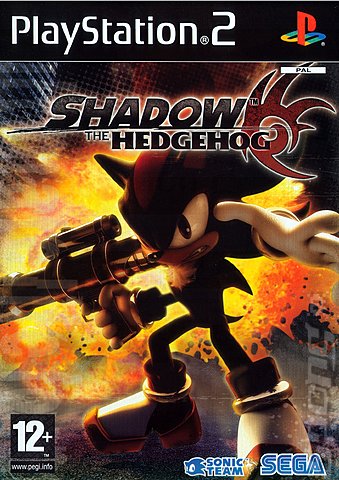
At first, Shadow the Hedgehog seems like a joke, perhaps even a parody of the darker games whose popularity was eclipsing platformers around the time that this game came out. I mean, really, read the synopsis I gave for the story up there again. Who could take that seriously? The box art shows an angry-looking Shadow holding a gun in front of an explosion, as if making fun of over-the-top shooters, and you'll be thinking the same thing when you watch the CGI opening. It starts off showing Shadow - who is a three-foot tall, cartoony hedgehog by the way - loading a gun and slowly approaching the edge of a cliff, followed by a montage of scenes including such things as Shadow (who can run several times faster than any vehicle) riding a motorcylce while being chased by angry black birds and jumping off of it before it collides with an object (naturally followed by an explosion), as well as a scene where Shadow just fires at the camera and screams. Need I even mention that an angsty nu-metal-ish song is playing in the background the whole time? Each of the menu screens in the game features a gunshot sound effect playing with every selection. One of said menu screens shows Shadow's face with fire burning in his eyes. It's so cliched that there's no way it could be taking itself seriously. And I'd like to reiterate: the main character of this game is a three-foot-tall, cartoonish hedgehog.

This parody feeling doesn't end when you start playing: Shadow shouts PG-rated profanities almost every time he gets hit or dies, and you also get the ability to use firearms against your enemies. The humans you'll be fighting don't bleed - at all - and the green blood effect seen when killing the aliens is very cartoonish. Heck, the humans don't even die. They just lie there begging you not to kill them. The violence and cursing is kept under control just enough to secure an E10+ rating, and this is a franchise that, up to this point, had never shown a drop of blood or featured the usage of a single curse word, mild or otherwise. And it stars a three-foot-tall, cartoonish hedgehog. It's so tame yet so out of place. Oh, Sonic Team, we always knew you had a sense of humor. So, if this is so obviously a parody, why was it poorly received?

Because when you play it, you realize that it takes itself seriously the whole time. That, and it has some of the worst gameplay and level design in the entire series.

Yes, you are, in fact, meant to take this seriously. What.

The main gimmick of Shadow the Hedgehog is that what stages you will end up visiting and the direction of the story will change depending on your actions in the levels. On paper, this sounds like a fantastic idea for the franchise, as it would add a lot of replay value to an otherwise short game. In practise, though, it's one of the worst things ever introduced to the franchise - and when you're up against Big the Cat's fishing stages in Sonic Adventure and the freaking Werehog in Sonic Unleashed, that's saying a lot.

Basically, the path you take is based on your moral decisions - whether you want Shadow to team up with the good guys (Sonic, his friends, and the humans) or the bad guys (the aliens), or if you just want Shadow to be neutral. Let's talk about what's wrong with this from a story perspective first. First of all, no matter what side you're on, both parties will be shooting at you. Joining the aliens? Alien enemies will still try to kill you. Joining the good guys? The good guys will still try to freaking kill you. To its credit, the good guys being after you has an in-story explanation: a military commander - who, as a bit of trivia, is never at any point officially named even though he is a very important character - holds a grudge against Shadow for some reason and is able to order his troops to go after Shadow, completely ignoring the fact that Shadow has ended up as a relatively innocent good guy for the last few games. It's an incredibly stupid explanation, but it's an explanation nonetheless. The aliens, though? Choose the "Dark" mission and they will still shoot at you for no explained reason. For another thing, this leads to many, many plotholes and inconsistencies. Oftentimes, Shadow will go from location to location without any sort of explanation. Sometimes you'll see a teleportation effect, but that only raises the question of HOW he got teleported. You can also switch sides at any time in any level, and previous "betrayals" are never referenced at any point. Doing something that conflicts with the moral path you're taking, such as striking down a human soldier when doing a "Hero" mission, holds no consequences whatsoever other than being told off by the character accompanying you and is sometimes even required to progress through a level. This is, simply put, lazy.

That's not even getting into how horribly this translates into the gameplay. Remember the annoying Team Chaotix levels from Sonic Heroes? The ones that required you to search for items or objects in a level that was linear in design? Now, imagine them stretched over an entire game and made about twenty times more frustrating and annoying with an even worse camera. That's Shadow the Hedgehog in a nutshell. Both the "Hero" and "Dark" missions generally require you to hunt for items or enemies in a linear level, and there is no room for error. One level's "Dark" mission asks you to kill fifty military robots. How many are there? Fifty exactly. This template is used for the "Hero" and "Dark" missions in nineteen of the game's twenty-two levels. The other three are open-ended in design, yet end up being even more torturous. The landscapes are completely repetitive and the camera is the worst the series has seen yet - which is saying a lot - leading to stages that are extremely easy to get lost in. And like I said, to complete a mission, you have to find EVERYTHING. It's almost insulting that, as you perform actions considered good, a blue bar in the upper right corner of the screen starts to fill up (the same goes for a red gauge in the upper left corner as you do things that are considered evil). If it fills all the way up, you can use one of Shadow's Chaos powers. Sounds good, right? It would be if this particular power didn't cause you to boost forward really fast, past things you need to find to complete the mission.

Oh, but doesn't the game still have your typical "point-A-to-point-B" missions? Those should at least be fun, you may be thinking. Indeed, there are missions that simply ask you to run to the goal, (usually a level's neutral mission) and they are, in fact, the most tolerable...but that's not saying much at all. The level design in Shadow the Hedgehog is laughably bland. It's mostly just running in a straight line with a few loops and some enemies. That's it. There's no semblance of a genuine challenge here, and what precious little platforming the game features is so utterly forgettable that it might as well not even be there.

Like the level design, Shadow the Hedgehog's bosses pose no challenge to you whatsoever. All you have to do is find a gun, then just blast away. Can't find a gun? Don't worry, the homing attack will do just fine, too, even if it will take a little longer to beat the boss. What makes this even worse is that the same final bosses are used for more than one of the different story paths. I see that 2005 Sonic Team liked being lazy quite a bit. I would also like to note that this is the first time a true final boss in a Sonic game has ever left me disappointed.

I am not pleased with you, Sonic Team.


And lest we forget how Heroes cheaply extended its length by making you play through the exact same game four times with few changes. Shadow pulls a similar trick. Each final level has a "Hero" and "Dark" mission. The final boss you fight and, by extension, the ending you receive changes depending on which of the two missions you complete. There are five final levels and thus ten endings. You have to get all ten to unlock the last story, and you will receive the true ending to the game if you beat that. Since allowing you to use the level select to make things quick would be too fair, you'll definitely end up going through the levels you already went through several times and probably even completing missions you already completed. There you are being lazy yet again, Sonic Team. Speaking of the endings, they're all so similar and formulaic that I can give a basic rundown of each without technically spoiling anything: Shadow gets all the Chaos Emeralds, says "Finally, I've got ALL the Chaos Emeralds!", states "I am Shadow the Hedgehog," has an epiphany, declares "This is who I am!", credits. You've got to appreciate the effort here.
But how could I go this far into the review without mentioning the numerous, numerous technical flaws? Actually, I did already mention the camera, but I believe it deserves mentioning again. Sonic Adventure was released in 1999, and its camera could get pretty annoying at times. It was at least somewhat justifiable, though, since it was Sonic's first step into 3-D. Even Super Mario 64 had an annoying camera, albeit less so. Sonic Adventure 2's camera was still flawed, but they had at least tried to improve it. Sonic Adventure 1 and 2 were later rereleased for GameCube, and the camera wasn't improved at all, and Heroes featured a camera that was even more annoying. So, Shadow the Hedgehog came out in 2005, after ALL of these games, and it features the worst camera yet. Not only does this mean that Sonic Team couldn't program a competent camera system after developing 3-D Sonic games for six years, but that they only got WORSE at it. Not to mention that in a game where you're going to spend most of your time searching for things, you NEED a camera that's at least somewhat reliable. Even aside from the camera, Shadow's controls are annoyingly slippery, and the vehicles like cars and motorcycles - which are utterly pointless in a game where the main character is supposed to be able to run faster than the speed of sound - tend to control even worse. The auto-aim the guns use is even less reliable, at times being too sensitive and at times not being sensitive enough, and the only thing keeping them from being completely useless is the fact that bullets kill faster than the homing attack. Also, like Sonic Heroes, the game can get kind of glitchy at times. The light dash and homing attack can still backfire just like before, but now some areas won't load completely before you enter them, meaning you can fall into a black void where a solid floor should be and die. An even more frustrating glitch is when enemies - that you often NEED to kill to complete a mission - won't spawn, meaning you'll have to restart the level if you want to complete said mission. I know that at this point I shouldn't expect much from you, but what the heck, Sonic Team?

Finally, the graphics of Shadow the Hedgehog are utter garbage even for its time. Wait, the graphics in Heroes were pretty good, so how could they screw THAT up? Well, part of why Heroes' graphics looked good was because they were bright and colorful, like you would expect from a Sonic game. Shadow is supposed to be DARK AND EDGY, and thus Sonic Team thought the environments should look darker and more subdued. This shouldn't automatically lead to the graphics looking like crap, but apparently Sonic Team thought "darker and more subdued" meant "muddy-looking with blurry textures". Character models don't fare much better; facial animations look like crap and the human characters are blocky. I would expect that from a Dreamcast game released in 1999. I wouldn't expect that from a PS2 game released in 2005. The next problem with the graphics may be exclusive to the PS2 version, but it has the WORST framerate I have ever seen in a video game. There is not a single moment where the game doesn't look slow or choppy, and that is simply unacceptable.

Pretty much the only thing about Shadow I can say legitimately doesn't suck is the music. I absolutely love almost all of the stage BGM's in the game. Shadow also has the distinction of having the most vocal tracks I like out of the entire Sonic series. "I Am (All of Me)", "Almost Dead", and "Waking Up" aren't all that great in my opinion, but I actually really liked "All Hail Shadow", "Never Turn Back" and especially "Chosen One". Sure, it's angstier than anything Linkin Park has ever written (okay, that's probably a HUGE overstatement), but darned if it doesn't sound good.

---------------------------------

Shadow the Hedgehog is quite possibly one of the worst games I've ever played. The gameplay sucks, the level design sucks, the graphics are garbage, the story is atrocious, it's rife with technical problems, it tries to cheaply extend its length, and finally, the "dark" tone is incredibly stupid. The only thing saving it from a 1/10 is its soundtrack. What's really sad about the whole thing is that this was a story that just didn't need to be told. We already knew everything we needed to about Shadow; the information that was revealed in this game was not only unnecessary but completely ruined Shadow's back story. I can understand having to resolve loose plot threads from Heroes such as Shadow's amnesia, but did they really need to make an entire game to do that? And did they really need to do it this horribly?

But perhaps the saddest thing about it all is that things only got worse for the Sonic series from here. After Shadow, this happened:

It honestly made me wonder how I've been able to remain a fan for so long. Sonic and the Secret Rings was bad, albeit less so than Shadow and 06, and the same goes for Black Knight. Even Unleashed, though a decent game overall, was a disappointment thanks to the stretchy-armed monstrosity known as the Werehog. Yes, Colors was great and Generations is shaping up to be even better, but how was I able to keep buying the horrible games without losing enthusiasm until Colors happened? The answer is because when Sonic started going downhill, I was young. Young enough to look past the flaws; young enough to squeeze enjoyment out of these awful, awful games. Yes, there was once a time when I enjoyed Shadow the Hedgehog, and I'm darned glad there was. Otherwise, I might not have seen Sonic through until he got good again. I hope many of my fellow fans had a similar experience growing up.

*ahem* Yes, sorry for that little tangent. Anyway, Shadow the Hedgehog is an unholy abomination of a game and an insult to the series that it belongs to. Pick up the OST, but avoid the game itself like the plague. T-Man, out.

Score: 2/10


My Scoring System:

10 - Amazing game. Flaws are minor at best. If you don't own it, you should be ashamed of yourself. (Super Mario Galaxy 2)

9(.5) - Fantastic game. Perhaps a couple of notable annoyances, but still a must-have. (Kingdom Hearts: Birth by Sleep)

8(.5) - Very good game. Has a few flaws, but you won't be disappointed with your purchase. (Super Mario Sunshine)

7(.5) - Pretty good game that either has several problems or is just too short for its price. Enjoyable to play, but you may want to wait for the price to drop a bit before picking it up. (Sonic Unleashed)

6(.5) - Passable game. Has its strengths, but unless you're a fan of the series or genre, you're probably better off not bothering. (Mega Man X6)

5(.5) - Mediocre game. Not a bad experience, but it's too flawed to be much fun. A bargain bin purchase at best, and only if you're a fan of the series. (Sonic Heroes)

3 or 4(.5) - Bad game. A mostly negative experience, and whatever it does right fails to save it overall. Even if you're a fan, you're probably better off not playing it. (Sonic and the Secret Rings)

1 or 2(.5) - Utter garbage. An unholy abomination that we should do all in our power to avoid playing. In other words, STAY THE HECK AWAY! (Sonic the Hedgehog 2006)

0 - ...No. Just freaking no. (Big Rigs: Over the Road Racing)

Wednesday, August 10, 2011

Super Mario Sunshine Review


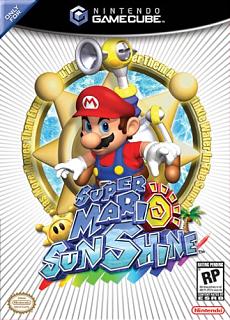
As those who have read my Viewtiful Joe review will know, lately I have been clearing some games out of my GameCube backlog. This ended up bringing me to a nostalgic favorite, Super Mario Sunshine. It was not in my backlog per se, as I had already beaten it. However, it was the only 3-D game in the entire Mario series that I had yet to complete 100%, and I intended for that to change. With all that said, it is sometimes considered the non-spinoff Mario game that leans closest to "ehh". Is it as great as I remember it, or is it more nostalgia gone to waste like Sonic Heroes? Time to find out!

------------------------------

In Super Mario Sunshine, Mario, Princess Peach and a few of her toadstool servants are going on vacation to the "sun-drenched tropical paradise of Isle Delfino." The plane comes to a screeching hault at the airstrip in order to avoid a strange goop covering the landing pad. While exploring the airstrip looking for help, Mario comes across the cleaning robot FLUDD (Flash Liquidizer Ultra Dousing Device - yes, that is the official acronym), which Mario uses to clean the sludge off of the airstrip. Upon doing so, he is confronted by local police and is put on trial for spreading paintlike sludge over the island (which has apparently caused the Shine Sprites, the guardians of Isle Delfino, to run away, which has, in turn, caused the island to get darker), with his sentence being to clean up the island. We quickly find out that the one who did this is an imposter named "Shadow Mario", and thus begins an epic adventure that inevitably features the capture of Princess Peach yet again. Oops, did I just give a spoiler?

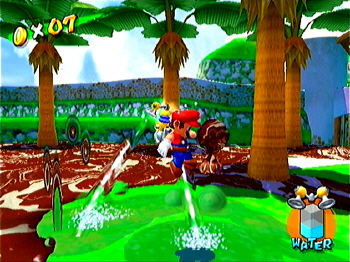
Gameplay-wise, Sunshine uses the template that 64 established: you are put in an open-ended stage and given missions to complete. Completing one of said missions allows you to receive one of the featured macguffins (Shine Sprites this time around, rather than Stars), of which you will need a certain amount to complete the game. However, Super Mario Sunshine adds a new gimmick to this formula: your trusty water-shooting backpack, FLUDD. FLUDD has several nozzles, used for different purposes. The spraying nozzle is the default nozzle, and you will have it with you at all times. It does just what you think it would do: it sprays water at things. You will be required to use this ability to clean up the toxic sludge that Shadow Mario has left in the various worlds, but it can also be used to stun enemies and sometimes even interact with the environment. Another nozzle (which you will start out with, but can be traded in for other nozzles) is the hover nozzle, which you can press the "X" button to switch to. It functions as sort of a water-shooting jetpack lite, allowing you to traverse the world more easily. There are two more nozzles that you can switch the hover nozzle out for: the rocket nozzle, which propels to extreme hights, and the turbo nozzle, which finally allows Mario to run as fast as Sonic the Hedgehog - it's about freaking time. This may sound like a stupid gimmick, but it's actually pretty unique and interesting. You will be putting the spraying and hover nozzles to great use throughout the game, and the rocket and turbo nozzles have their own missions and secrets associated with them and are pretty fun to use. Also, what other game lets you do so much with just water? I mean, really?

Sunshine's worlds feature less of a focus on conventional platforming than its predecessor, Super Mario 64, and what conventional platforming there is is usually made easier thanks to the hover nozzle. In return, however, Sunshine's levels are far bigger and more open-ended than anything that 64 had to offer. The game also reintroduces blue coins as separate collectible items from normal coins. There are far less of them, and ten of them can be traded at a certain store for Shine Sprites. Thirty blue coins are hidden in each area, making exploration a lot more rewarding. Of course, a Mario game without difficult platforming might as well not be a Mario game at all, which is why some missions will require you to visit "secret" levels. These secret levels feature platforming that is reminiscent of the classic Mario games (but in 3-D) yet remain very unique and even creative. Also, upon entering secret levels, FLUDD is taken away from you, making for a very difficult and fun platforming experience. These secret levels may also be revisited later on (with FLUDD) to collect red coins for an extra Shine Sprite.

Sunshine also features fewer worlds than 64 - seven as opposed to 64's fifteen. However, it again makes up for this in several ways. While it doesn't have as great of a variety of levels, its locales do remain very diverse while still sticking to the theme of a tropical resort island. Several aspects of the levels will change depending on which mission you are playing, including what NPC's you will see as well as what they say, making the levels feel more alive than ever. Speaking of missions, Sunshine features much greater variety in mission structure than Super Mario 64, and the areas feature more missions overall. Besides missions requiring you to chase down Shadow Mario, every mission asks you to do something different. Even missions requiring you to hunt down eight red coins tend to have a different, interesting spin put on them. The game also features several bosses, and while none of them are qute difficult, they are actually very creative and unique as well as a LOT of fun to battle. Even aside from all this, the levels offer a lot more to do overall. There is the aforementioned blue coin hunting, of course, but there are also two hidden Shine Sprites to get in each world, and, like in 64, you can get one last Shine Sprite by collecting 100 normal coins. Many of these attributes extends to the game's featured hub world, Delfino Plaza, which changes as you continue through the game and collect more Shine Sprites and contains many more secrets than Princess Peach's Castle in 64. Overall, I found it to be a far more engaging hub world.

There are two more positive aspects to the game that I feel deserve mentioning. The first is the graphics. The graphics were absolutely amazing at the time, and despite the game being nearly ten years old, it's actually still visually appealing if not technically stunning. The environments are all as bright and colorful as you would expect, and the lighting effects are great. Some of the textures are blurry, but it still looks really good overall. Finally, this was 3-D Mario game that allowed you to ride Yoshi. This may not seem very big, but hey, it's still cool, and he will prove very useful in certain missions and in finding blue coins.

But although Sunshine is a great game, it does unfortunately have a couple of genuine flaws. First of all, the camera in this game is not very good. There will be times when your view will be annoyingly obstructed before the camera catches up to you, and it's not always easy to see where you need to go next. Often, trying to move it with the "C" stick or center it with the "L" button won't help much or can even make it worse. It's not quite something you would expect to see in, say, a Sonic game, but it can be an annoyance. What IS something you would expect to see in a Sonic game is the noticeable lack of polish. Don't get me wrong, the game is far from broken; you will mostly just see some minor oddities. However, there were some disconcertingly frequent annoyances that almost made me wonder if SEGA had developed the game, including three collision detection issues I experienced that came right out of no where and caused me to go through an otherwise solid object. Another example of this lack of polish is a segment toward the end of the game where you have to navigate a boat across a pool of lava that will sink if it hits an object. The method of controlling the boat is that you spray over the side of the direction you want to go in, but there were times when the sides you would need to spray over would randomly invert, making an already difficult area downright frustrating and cheap. Ultimately, I found this issue annoying enough to lower the score down a bit from the 9/10 I initially wanted to give it. Really, Nintendo, I expect more from you.

-----------------------------

While it feels more rushed and unpolished than what Nintendo usually puts out, Super Mario Sunshine is still a great game, featuring a neat gimmick, great variety in mission structure, and a lot to do overall. It's sometimes considered to be the weakest 3-D entry in the series, but while 64 is probably more polished, from a gameplay perspective Sunshine does improve on several aspects of 64. If you own a Wii or GameCube and you're a fan of platformers, this is not a game that you should pass up.

Score: 8.5/10


My Scoring System:
10 - Amazing game. Flaws are minor at best. If you don't own it, you should be ashamed of yourself. (Zelda: Ocarina of Time)

9(.5) - Fantastic game. Perhaps a couple of notable annoyances, but still a must-have. (Kingdom Hearts: Birth by Sleep)

8(.5) - Very good game. Has a few flaws, but you won't be disappointed with your purchase. (Klonoa)

7(.5) - Pretty good game that either has several problems or is just too short for its price. Enjoyable to play, but you may want to wait for the price to drop a bit before picking it up. (Rayman 3D)

6(.5) - Passable game. Has its strengths, but unless you're a fan of the series or genre, you're probably better off not bothering. (Dragon Ball Z: Budokai Tenkaichi 2)

5(.5) - Mediocre game. Not a bad experience, but it's too flawed to be much fun. A bargain bin purchase at best, and only if you're a fan of the series. (Mega Man X7)

3 or 4(.5) - Bad game. A mostly negative experience, and whatever it does right fails to save it overall. Even if you're a fan, you're probably better off not playing it. (Sonic and the Secret Rings)

1 or 2(.5) - Utter garbage. An unholy abomination that we should do all in our power to avoid playing. In other words, STAY THE HECK AWAY! (Dragon Ball Z: Ultimate Battle 22)

0 - ...No. Just freaking no. (Big Rigs: Over the Road Racing)